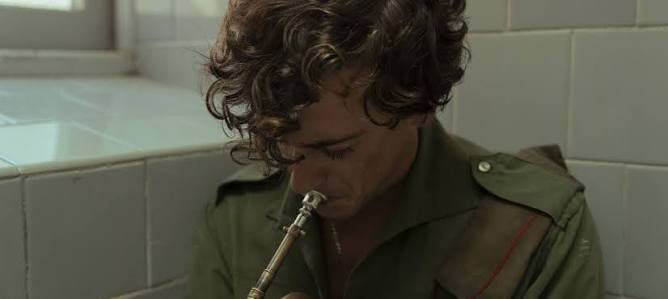
La Bola Negra is a 2026 Spanish drama film directed by Javier Calvo and Javier Ambrossi, from a screenplay they co-wrote with Alberto Conejero. The plot was inspired by an unfinished play (of the same name) by Federico García Lorca and the play La Piedra Oscura by Alberto Conejero. It had its world premiere at the Cannes Film Festival in May, and was released in the UK yesterday, 6 November 2026.
La Bola Negra explores the connections between three gay men over three different time periods. It combines real characters with fictional ones and interweaves extracts from Lorca’s body of work in order to create a beautifully realised, sprawling, poetic epic. There are three primary strands: 1932: in Granada, Carlos (Milo Quifes), a young man from a wealthy family, is refused membership of an exclusive social club (“black-balled”) due to rumours of his homosexuality; 1937: during the Spanish Civil War, Sebastián (Guitarricadelafuente) survives an attack by Italian aircraft on his village and, whilst fleeing, is captured and forced to join the Nationalist forces to survive. He is assigned to guard Rafael Rodríguez Rapún (Miguel Bernardeau), a wounded Republican prisoner of war; and 2017: Alberto López Azcuna (Carlos González), a former playwright, is left an inheritance by his maternal grandfather (who he has never met), provided he travels to Cantabria to collect it from a lawyer.
The film skilfully weaves these strands together and what initially seems an almost impenetrable mishmash of story lines gradually becomes one clear coherent and very satisfying piece of storytelling.
The actors in the main roles are all terrific, and there are wonderful turns by Glenn Close as Lorca scholar Isabelle Durand and Penélope Cruz as Nené Romero, a cupletista entertaining the troops. (A cuplé was a popular risqué song style from the late 19th century, a feature of the lowest type of Spanish cabaret theatre.)
The screenplay, which combines the initially disparate strands into this complex powerful epic story is extremely well crafted and the direction is inch-perfect – at no point during its 159-minute running-time did it feel slow or baggy. The music, which is critical to the film, was pitched perfectly and the inclusion of Lorca’s exquisite poetry lifted the piece to a heightened level that is rarely achieved in the cinema.
La Bola Negra is quite simply a masterpiece – catch it on the big screen while you can!


Leave a Reply