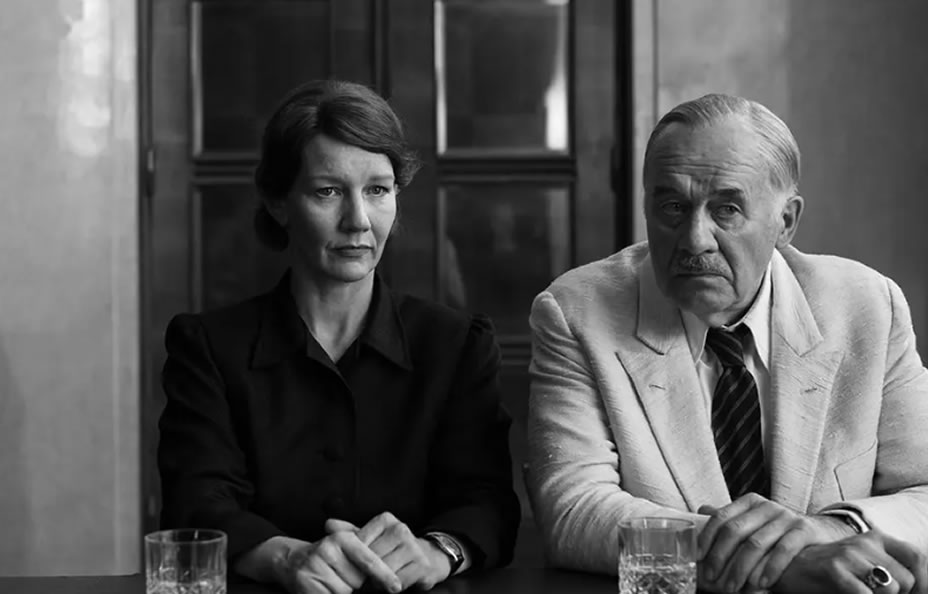
Fatherland is a 2026 drama film, directed by Paweł Pawlikowski, from a screenplay he co-wrote with Hendrik Handloegten. I avoid using adjectives such as historical or biographical, because I do not believe that was ever Pawlikowski’s intention, as I will discuss further below. The film had its world premiere at the Cannes Film Festival in May (where it won the Best Director award) and went on general release in the UK last Friday, 23 October.
In 1949, after a sixteen-year exile, Nobel Prize winning German writer Thomas Mann (Hanns Zischler) returns to the land of his birth to receive the Goethe Prize. Feted by both sides of the newly divided Germany, he actually collects two prizes: the annually awarded prize in Frankfurt, West Germany, where Goethe was born; and the inaugural East German prize in Weimar, where he spent much of his life and is buried. During his visit, Mann held press conferences and made speeches which both the East and West tried to seize upon for political advantage, but at the end of the visit he returned to his ‘home’ in California, despite the claims on him from both sides of the political divide. This much is historically true, and it is this framework upon which Pawlikowski has hung his drama.
However, Fatherland is more of a character study than a biographical drama. We see Thomas Mann warts and all, exhibiting an astonishing sense of self-importance, almost as big as, well, his actual literary genius, I guess! (We must remember that Mann’s Nobel Prize specifically recognised his first novel Buddenbrooks which was written in his early twenties and published when he was just twenty-six). However, the war is very recent and raw in Germany; Mann’s eldest son Klaus has recently committed suicide; and perhaps his focus on his own literary value is misplaced, or at least untimely. Whilst in real life Mann was accompanied on the trip by his wife, Pawlikowski has substituted his eldest daughter Erika (Sandra Hüller) as his companion. An important writer and journalist in her own right, she is the perfect foil for his ego, on the one hand greatly admiring his undoubted genius, on the other having a Worldview which is firmly rooted in reality.
To add further to this artistic and literary miscellany, Pawlikowski has noted the parallels between Mann and the fictional Professor Isak Borg in Ingmar Bergman’s Wild Strawberries and has borrowed both structurally and thematically from Bergman. Indeed, there were several scenes in the film when I had to remember I was looking at Zischler’s Mann and not Sjöström’s Borg, such were the similarities between the two.
All this combines to give us deep, rich, multi-layered character studies of both Thomas Mann and his daughter Erika. I have seen the film twice over the last two weeks (and rewatched Wild Strawberries in the meantime) and I have loved every minute of it. I have no qualms in strongly recommending Fatherland. I say no qualms, however it occurs to me that there is a lot in the film where a prior knowledge of Thomas Mann is beneficial. Whilst you do not need to know his work inside out, I think a reasonable grounding in who he was is useful ‘homework’ before seeing the film – at the very least, read his Wikipedia page during Pearl and Dean.


Leave a Reply