RICHARD’S BLOG

  • REVIEW: Little Trouble Girls ★★★★☆

    Little Trouble Girls is a 2025 Slovenian coming-of-age drama, written and directed by Urška Djukić in her directorial feature debut. It had its world premiere at the 2025 Berlin International Film Festival, and received its UK theatrical release last Friday, 29 August.

    This seemed a strange title to me, however I understand it comes from a song by Sonic Youth, which plays during the closing titles, so I guess that makes sense. A literal translation of the Slovene title would be What’s up, girl?

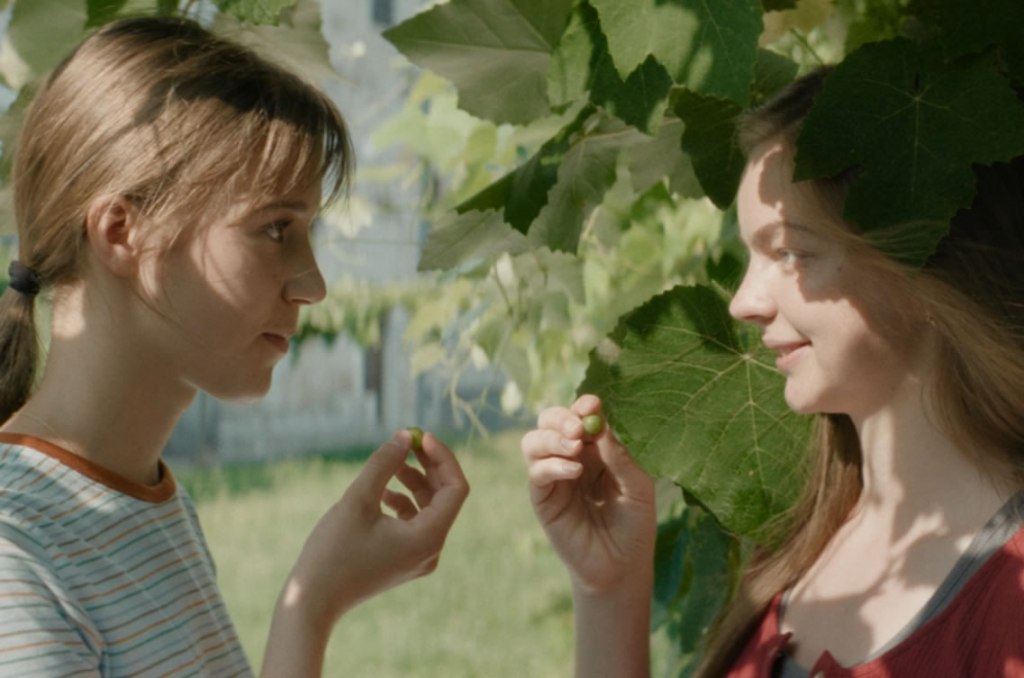
    Sixteen-year-old Lucija (Jara Sofija Ostan) is a painfully shy pupil at a Catholic school with an extremely controlling mother who has deliberately suppressed her sexual maturation. She joins the school’s all-girls choir and befriends the worldly and charismatic Ana-Marija (Mina Švajger). The choir goes on a residential retreat to a rural Italian convent in order to rehearse in peace, however they are disturbed by ongoing restoration work. From the beginning there is a strong sexual tension between the two girls, with a degree of low-level experimentation, however Lucija’s attraction to a male restoration worker creates an altogether different tension between the girls. When she opens up to the choir’s conductor (Saša Tabaković) about the now-unwanted advances of her friend, he betrays her confidence and turns out to be a monstrous bully who makes her life unbearable.

    Whilst that outline of the plot may seem a little clunky, the film itself is far from this. It is full of flights of fancy and symbolism, much of which seems to go on in Lucija’s head, and the choir’s ethereal harmonies heighten the sensuous (and indeed sensual) mood, lifting it far above the usual cliché which a Catholic girl’s sexual awakening seems to have become. Whilst the symbolism itself may at times seem a little unsubtle (lots of flowers opening and a medieval illustration of Christ’s wound on a reredos that resembles… you get the picture), this does not impair the generally smooth ‘flow’ of the film.

    Little Trouble Girls is an exceptionally assured first film, which reminded me of the early films of Céline Sciamma, and I look forward to seeing more of Urška Djukić’s work in the future. Incidentally, I believe this may be the first Slovenian film I have ever seen.

  • REVIEW:  Love     ★★★★☆

    Love is a Norwegian drama film with adult themes, written and directed by Dag Johan Haugerud. It had its world premiere at the 2024 Venice International Film Festival, where it was nominated for both the Golden Lion and the Queer Lion. It received its UK theatrical release on 15 August 2025.

    It forms the second part of the Oslo Stories Trilogy, which consists of Sex, Love and Dreams (Sex Love). I saw Sex, the first part of the trilogy, at the 2024 BFI London Film Festival, and went along to the Hyde Park Picturehouse in Leeds on Friday for Love. No doubt in the not-too-distant future there will also be Dreams.

    Haugerud has said that he was inspired by Kieślowski’s Three Colours trilogy, and that the three films “should look and feel very different, but give the impression that they are all part of the same conversation.” The conversation to which he refers is an exploration into modern approaches to sex within Norwegian society, in particular looking at the different philosophies between the heterosexual and homosexual worlds. I think.

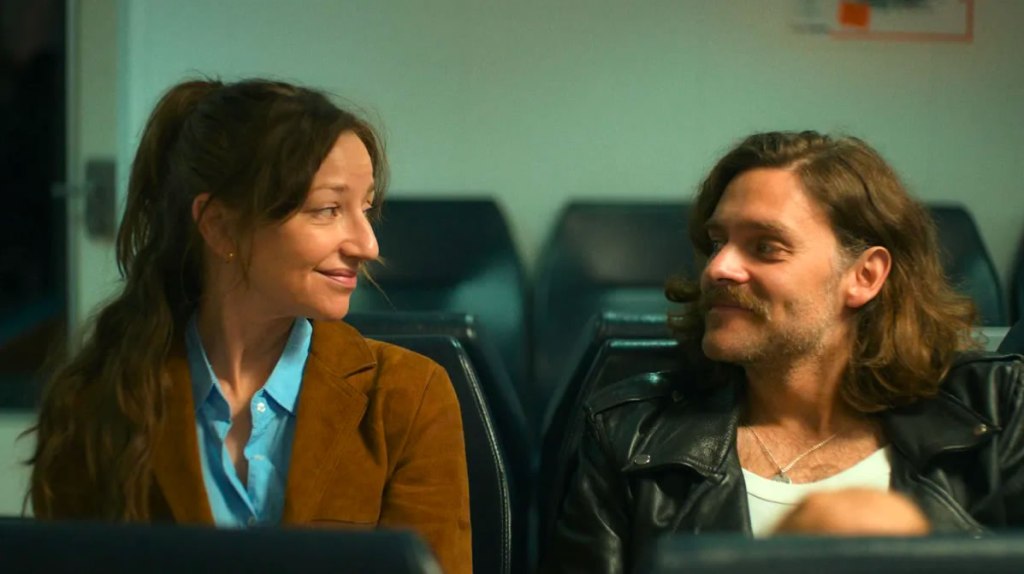
    Anyway, the film is set in Oslo, of that I am certain. It concerns two colleagues in a Hospital Urology Department: a consultant, Marianne (Andrea Bræin Hovig); and a nurse, Tor (Tayo Cittadella Jacobsen). Tor is gay and explains his somewhat casual approach to sexual encounters to Marianne; she wonders if such an approach would work for her, dispensing with the baggage that tends to come with most heterosexual encounters. And so she explores this possibility, much to the disapproval of her best friend Heidi (Marte Engebrigtsen), who instead tries to set her up in a more traditional relationship with a twice-divorced friend. However, it is Tor who is to develop a more serious relationship with one of his hook-ups, who turns out to be a urology patient at the same hospital, recovering from an operation to remove his prostate.

    The film treats these issues in a very open and grown-up way and whilst it is fun and engaging, it is also a serious conversation on modern sexual practices, as was Sex which dealt with the fallout from a casual homosexual encounter by a married heterosexual man. I enjoyed both, though I think Love was the better film; I am looking forward to Dreams, which has been released but is proving difficult to track down here in the frozen north (Yorkshire, not Norway).

    If you are open-minded when it comes to matters of sex, then Love is certainly worth a visit (as is Sex).

  • REVIEW:  Young Mothers        ★★★★★

    Young Mothers is a 2025 drama film, written and directed by Belgian brothers Jean-Pierre and Luc Dardenne. It had its world premiere at the 2025 Cannes Film Festival, where it won the Best Screenplay prize and was nominated for the Palme d’Or, and received its UK theatrical release yesterday (29 August). So I went along to the Hyde Park Picturehouse in Leeds with very high expectations – and I was not disappointed.

    The film is set in in a state-funded support facility for teenage single mothers in Liège, Belgium. It follows the stories of four girls: Perla (Lucie Laruelle), Jessica (Babette Verbeek), Julia (Elsa Houben), and Ariane (Janaïna Halloy Fokan) and also touches on a fifth, Naima (Samia Hilmi) who is preparing to leave the facility. We watch them as they get to know their babies, whilst also attempting to come to terms with the harsh realities of their own lives.

    The film includes drug dependency, mental illness, the lack of proper parental support, abortion and adoption. Bleak stuff, you might think, but in the deft hands of the Dardenne’s that is not the case – whilst it certainly pulls no punches, it is also light and hopeful and ultimately wonderfully uplifting. The girls are little more than children themselves, yet it is a joy to watch them learning to feed and change and bathe their babies in the hands of the caring, but down-to-earth, almost to the point of being strict, support staff. There are no easy answers – for every tentative step forward, there are snags and setbacks.

    It is the simplicity and humanity in the storytelling which make the Dardenne films so powerful – they never tell us what to think – they just show us a situation and leave us to make up our own minds. This is perhaps a bit of a departure, in that it is an ensemble piece, rather than being focused on just one or two principal characters. I believe it stemmed from a visit the brothers made to a real home in Liège.

    Every character is depicted honestly and with dignity; every scene is straightforward and unforced. The Dardennes do not create victims and heroes – they just show us real people doing their best, often in desperate situations. They have two Palme d’Or awards for Rosetta (1999) and L’Enfant (2005), which puts them into a very select group of nine directors – this could so easily have made them the only three-times winners.

    Young Mothers is an extremely powerful piece of storytelling. Go along and see it – you will not be disappointed!

  • REVIEW:  Materialists    ★★☆☆☆

    Materialists is a 2025 American romantic comedy-drama film written and directed by Celine Song. It is the Canadian playwright’s second feature as director, following her critically acclaimed debut Past Lives in 2023. Whilst that film was shown at both the Sundance and Berlin International Festivals prior to release, Materialists went straight to theatrical release in the United States on 13 June and internationally, including in the UK, on 16 August. This may be significant as it did feel more of a commercial offering than arthouse.

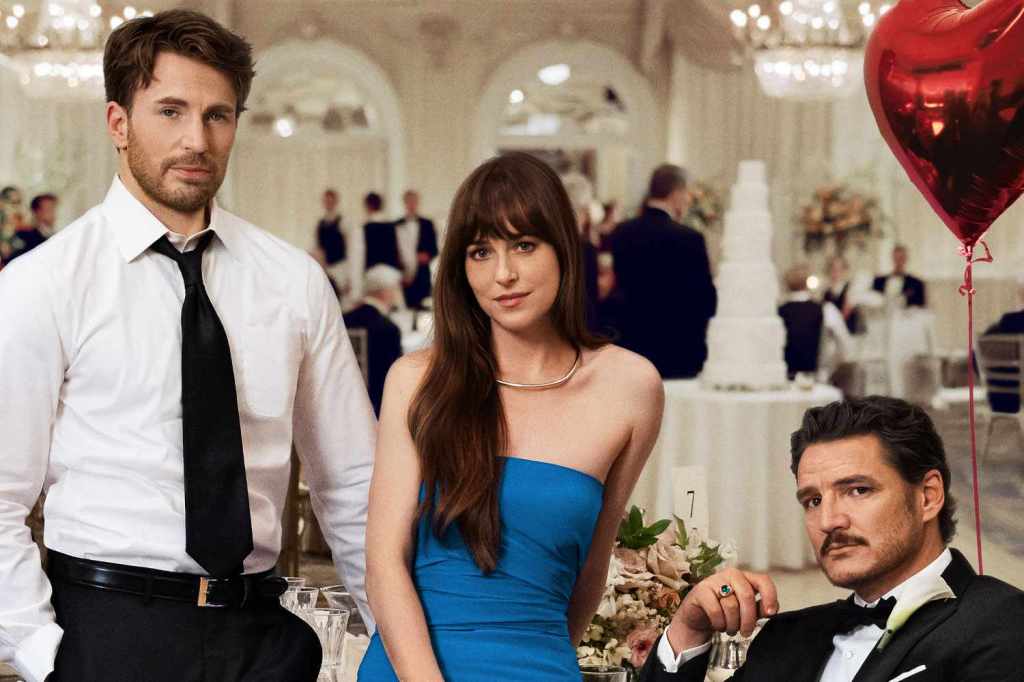
    Successful matchmaker Lucy Mason (Dakota Johnson) works at matchmaking company ‘Adore’ in New York. Whilst she sets her clients up with their perfect matches, and already has nine weddings under her belt, she maintains she will either die alone or marry someone exceptionally wealthy. At her latest wedding ceremony she is hit on by the groom’s brother Harry (Pedro Pascal) who ticks all her boxes when it comes to wealth and good looks (see below). Her struggling-actor ex-boyfriend John (Chris Evans) just happens to be temping as a waiter at the wedding. And so the tables are set (see what I did there) for a classic rom-com – she must decide between the rich and successful new guy and the true love from her past, who is poor as a church mouse. Sort of.

    I had some real problems with this. It is a satire on the modern digital dating scene – I get that. And so it is all about value (as opposed to values) and ticking boxes and perfect matches and so on. So the people are all shallow, one-dimensional, and not particularly likeable, making it difficult for me to get involved in their stories. So I was bored. To be fair, as a character she is aware that she is shallow, however that does not ring true: in my experience shallow people are the last to be aware of their shallowness. In the Harry Vs John playoff, I was rooting for John, the old flame, because I thought he was less plastic. Then he made an impassioned speech which, for me, completely blew away his credibility as a character.

    This was not my only problem. Secondly, I am informed by my fellow cinemagoer that Pedro Pascal is the latest international heartthrob – so can someone tells me why he has a 1970s gay-porn-star moustache?

    And my biggest problem? I absolutely loved Past Lives. It was beautifully written, beautifully realised and had interesting characters that one truly became involved with and cared about. So I had high expectations which were simply not satisfied by Materialists. However, everyone is allowed a mistake, so rest assured I will be at the front of the queue when Song’s next film is ready for release, providing she has lifted the restraining order which will no doubt follow this review!

  • REVIEW:  Young Hearts     ★★★☆☆

    Young Hearts is a 2024 gay coming-of-age drama, written and directed by Belgian Anthony Schatteman in his feature directorial debut. It premiered at the 74th Berlin International Film Festival in February 2024, but was only released in the UK on 8 August. 

    The film tells the story of Elias (Lou Goossens) a fourteen-year-old boy growing up in rural Belgium, and the effect that new arrival Alexander (Marius De Saeger) has on his life. Elias is part of a loving family and has an apparently long-term girlfriend, Valerie (Saar Rogiers) – but something is clearly missing. Alexander, brought up in Brussels and, as such, much more sophisticated than Elias, is openly gay and at just fourteen surprisingly comfortable with his sexuality.

    We watch as Elias falls in love with Alexander, fighting his own inner conflicts and prejudices to come to terms with his gayness. However, what is lacking is any real external conflict – it all seems rather too easy. Everyone accepts the changed Elias with barely a shrug of the shoulders and there is seemingly no problem for the young lovers going forward. This is, of course, how the world should be; but as we all know it isn’t. However, my real problem is, if this is a society where there is no genuinely little or no external conflict involved in coming out, why would there be so much internal conflict for Elias?

    There are obvious comparisons with Lukas Dhont’s Closer, a 2023 Belgian film on a very similar subject which was very sad and, ultimately perhaps, a tad more realistic. And maybe that is the point – where Closer showed the real-life problems for a teenage boy coming to terms with being gay, Young Hearts shows it how it ought to be in a perfect world.

    Incidentally, Elias’s father, Luk (Geert Van Rampelberg), is a middle-aged pop music sensation making hit records about appropriate subjects, first love, and so on; this may fit in with the ‘perfect world’ idea, but it seems more a comment on the parlous state of the Belgian music industry! Also, Elias’s Grandad is played by a Belgian actor called Dirk Van Dijck – how good is that?!

    I enjoyed Young Hearts – it is easy to watch and entertaining, but it rarely surprises.

  • REVIEW:  Late Shift   ★★★★☆

    Late Shift is a new Swiss medical drama, written and directed by Petra Volpe. It premiered at the 75th Berlin International Film Festival in February and was released in the UK on 1 August. 

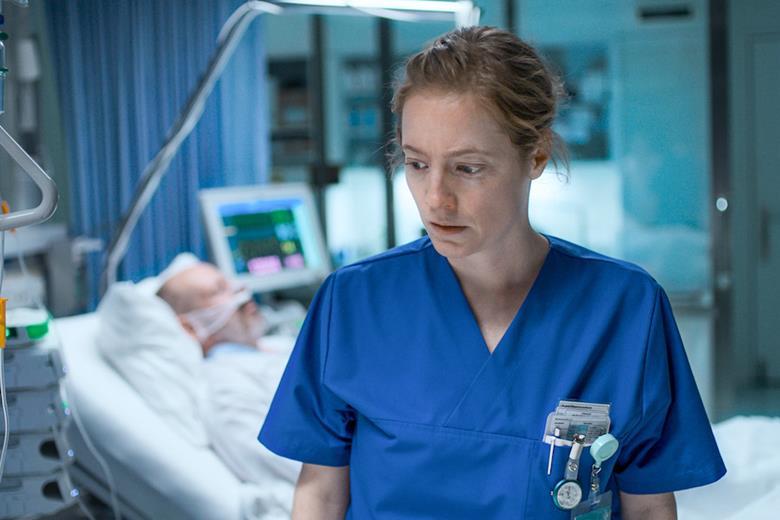
    The original German title is Helding, which literally translates as Heroine, and that is how the principal character, Floria (Leonie Benesch) is presented to us. From the very beginning, Floria works at a frantic pace, caring for 25 patients on a mixed surgical ward with just one other nurse and one trainee to assist.

    This is not a film about plot. Yes, a lot happens and yes, it is very dramatic in places, but this is a slice-of-life film about carrying out an essential role in a chronically understaffed hospital. The life and death dramas are going on all around Floria, and she has to cope with the needs of her patients and their relatives as best she can. However, the difference between this story and traditional hospital dramas is that the camera follows Floria as she does her job, rather than focussing on these individual patient dramas.

    There was plenty of light and shade, and whilst the pace was generally frenetic, there were moments of stillness (one particular moment where Floria sings a lullaby to calm an older patient with dementia sticks in the mind), moments of comedy and moments of tragedy.

    It was only during the closing montage of her patients settling down for the night that I had time to reflect on what I had just seen. At no other point did I consider that I was watching a film and that Leonie Benesch was an actress playing a role. My disbelief was well and truly suspended – Floria was real – her patients were real – and she truly was a heroine.

    If I have one criticism of the film, it is that too many loose ends were tied up at the end, which I felt was unnecessary. The nature of the job is that the loose ends remain loose ends and will still be there when her next shift commences the following afternoon. Having said that, the final shot on the tram was a near perfect ending!

    This is the third time in three years that I have seen and been impressed by Leonie Benesch – first in The Teacher’s Lounge in 2023 and second in September 5th last year. She was also in Michael Haneke’s wonderful The White Ribbon back in 2009, at the tender age of just 18.

    Late Shift is very sad, but ultimately important and, I felt, very rewarding. Go see it!

  • My ‘Top 3 and a Bit’ Films about Films

    For the last few weeks I have immersed myself in films about films. This meta, rather self-indulgent subject has attracted many of the heavyweight US and European directors over the past seventy years, several of them more than once, although strangely it does not seem to be of much interest to Asian directors.

    The actual content of the films varies enormously, covering between them virtually every aspect of filmmaking. The quality also varies enormously, and I have split my Honourable Mentions list into two halves – the genuine contenders and those which, whilst very good, were never really up there.

    So, here are my Top 3 Films about Films, together with notes on several additional films which are certainly worthy of attention:

    (1)          8 ½ (1963 – Federico Fellini)

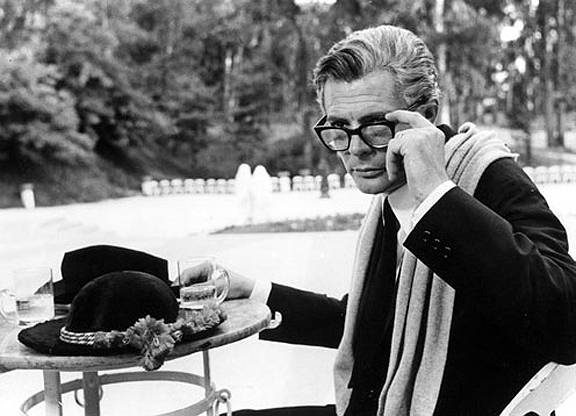
    8 ½ is a semi-autobiographical film about the creative process. At the time, Fellini had directed 7 other films and co-directed one – hence this would be his ‘eight-and-a-halfth’ film. The protagonist is Guido Anselmi (Marcello Mastroianni), a director suffering from writer’s block, trying to put together his next film. His producer has checked him into a spa for a rest-cure, however he gets little rest; instead, in his mind he constantly runs through all the women who have been significant in his life so far, in search of some kind of inspiration. The film is basically an exploration of the way the human mind works – a combination of observing reality, daydreaming, fantasising, and recalling memories. Since the mind jumps all over the place, so does the film: it has no linear structure. Each time I watch this film, I find something new; it is fascinating and confusing in equal measure. Do not expect it to be easy to understand – just enjoy trying! 8 ½ won the Oscar for Best Foreign Language Film in 1963.

    (2)          Pain and Glory (2019 – Pedro Almodóvar)

    Madrid-based filmmaker Salvador Mallo (Antonio Banderas) suffers from extremely poor health, rendering him unable to work. He is asked to attend a screening of one of his old films, Flavor, which has recently been restored. He has not seen the film’s star Alberto Crespo (Asier Etxeandia) for many years, having fallen out with him over his use of heroine during the filming of Flavor. He visits Alberto, who is still a user, to ask him to co-present the screening with him, and whilst there, bizarrely, he decides to try heroine himself. The heroine triggers long-buried memories of Mallo’s childhood and his route into filmmaking. There is an excellent performance from Penelope Cruz as his mother. Almodóvar draws on his own life in this subtle, yet powerful celebration of filmmaking, which both Time Magazine and the New York Times named best film of 2019. It was nominated for the Best International Feature Film Oscar and won multiple awards for both Banderas and Almodóvar.

    (3)          Day for Night (1973 – François Truffaut)

    This film is about the filming of a melodrama, Je vous présente Paméla, with a largely French cast but an English star, Julie Baker (Jacqualin Bissett) in the title role. Truffaut himself plays Ferrand, the director, and he is reunited with the star of The 400 Blows, Jean-Pierre Léaud, as Alphonse, a young French actor playing Pamela’s husband. Whilst the film gently pokes fun at the self-importance of some of the actors, it also considers whether cinema is more important than life to those who create it. We witness the myriad decisions the director must make every day, and the artificiality of filmmaking: the way it creates the appearance of reality rather than a version of reality. Indeed the title refers to the process of filming outdoor sequences in daylight with a filter over the camera lens to appear as if they are taking place at night. I particularly love the filming of the crowd scenes which bookend the film. Day for Night won the Oscar for Best Foreign Language Film in 1974 and also the BAFTA for Best Film.

    And the Honourable Mentions … (1) The Contenders

    The following films are those that came very close to making my Top 3, but did not quite get there (thefirst ‘bit’), listed in alphabetical order:

    Bergman Island (2021 – Mia Hansen Love)

    A romantic drama about a filmmaking couple visiting the island of Fårö, partly as a pilgrimage to the home of Ingmar Bergman and partly as a working retreat. Tony Sanders (Tim Roth), the ‘visiting director’ for the summer programme at the retreat, is confident and successful. Whilst on the island he, seemingly effortlessly, completes his new screenplay. His wife Chris (Vicky Krieps) is less confident and does not have Tony’s track record. As she struggles to develop her screenplay, she shares her ideas with Tony, looking for help and advice, and her film literally comes to life in front of us: a ‘film within a film’, a charming romantic comedy starring Mia Wasikowska and Anders Danielsen Lie. Bergman Island explores the creative process whilst also exploring the cracks in the Sanders’ relationship as they struggle to put together their next projects. There are clear parallels here with Hansen Love’s own relationship with fellow filmmaker Olivier Assayas.

    Broken Embraces (2009 – Pedro Almodóvar)

    Harry Caine (Lluís Homar) is a blind writer, who shares his life with his agent Judit (Blanca Portillo) and her adult son, Diego (Tamar Novas). Diego is hospitalized after an accidental drug overdose in a nightclub. Harry collects Diego from the hospital and looks after him to avoid worrying his traveling mother. Hearing that his nemesis, millionaire Ernesto Martel (José Luis Gómez), has died, Harry reluctantly tells the recovering Diego the tragic story of his love affair with Magdalena “Lena” Rivas (Penélope Cruz), Martel’s wife. The story, told in flashback, is a tragic Hitchcockian mix of jealousy, abuse of power, betrayal, and guilt. Almodóvar gives us his trademark primary-colours throughout this nouveau-noir thriller, but ultimately something much more sinister lurks just below the surface.

    Camera Buff (1979 – Krzysztof Kieślowski)

    Set in the late 1970s in Wielice, Poland, humble factory worker Filip Mosz (Jerzy Stuhr) becomes a father and begins filming his daughter’s first days, with a newly acquired 8mm movie camera. His reputation as an amateur filmmaker quickly spreads, and he is asked by the local Communist Party boss to film a jubilee celebration at the factory. His film is selected for a Polish Film Festival and from there he develops a fascination with the possibilities of film, which begins to transform his life. However, his naivety begins to show through, and in seeking artistic success, he risks losing everything he has. One reviewer wrote that “suffused with Kieslowski’s dry wit and intelligence, this early feature provides an excellent introduction to his work” I couldn’t have put it better myself!

    Cinema Paradiso (1990 – Giuseppe Tornatore)

    Salvatore Di Vita (Jacques Perrin), a famous Italian film director, returns to his home in Rome late one evening to be told that his mother called to say Alfredo has died. Unable to fall asleep, he revisits his childhood and teenage years at the ‘Cinema Paradiso’ in a small Sicilian town, and in particular his relationship with the ageing projectionist Alfredo (Philippe Noiret). Credited with revitalizing Italy’s film industry, and winning the Oscar for Best Foreign Language Film in 1989, Cinema Paradiso has been cited as one of the greatest films of all time. The ending is considered among the greatest endings in film history, so I had best not spoil that.

    Contempt (1963 – Jean-Luc Godard)

    I should open this paragraph by saying that when it comes to the French New Wave, one is either a Truffaut man or a Godard man; and I am definitely for Truffaut. Having said that, Contempt is a fascinating film and even I can see it deserves a place in this list. Paul Javal (Michel Piccoli), a young French playwright, has been asked to rework the script for Austrian director Fritz Lang’s adaptation of the Odyssey. As Javal and Lang (who plays himself in the film) debate the nature of adapting classics for the screen, producer Jerry Prokosch (Jack Palance), a vulgar American, sets his sights unsubtly on Javal’s wife Camille (Brigette Bardot). Camille looks to her husband for protection, but he is rather preoccupied with the screenplay, leaving her alone and vulnerable. The contempt of the title could refer to Javal’s treatment of his wife, or Prokosch’s treatment of everyone, or possibly even the film producers’ treatment of Godard. Whichever it is, it is well worth watching.

    Mulholland Drive (2001 – David Lynch)

    Mulholland Drive is described by Wikipedia as a surrealist neo-noir mystery art film – that pretty much covers all the bases. Ever since it was released, there has been much speculation as to what the film is actually about: which characters are real, and which are fantasies created by the real ones. Naomi Watts plays both Betty Elms and Diane Selwyn, and I feel pretty sure that one is real and the other is in the real one’s head. Probably. Laura Harring plays ‘Rita’ and Camilla Rhodes, but again it is not clear what represents reality. This is a hugely confusing film, but also a hugely enjoyable one; the 147 minutes flash by. To me this is David Lynch’s masterpiece and each time I watch it I think I am beginning to understand it. Or not. Either way, once you see it you will want to see it again; it is addictive.

    Peeping Tom (1960 – Michael Powell)

    Mark Lewis (Carl Boehm) picks up a prostitute, follows her into her flat, and murders her with a blade concealed in one leg of his tripod, all the time covertly filming her with a camera hidden under his coat. Mark works at a film studio. He arranges with Vivian, an actress at the studio, to make a film after the set is closed; he then kills her in a similar manner and hides the body in a prop trunk. He begins a relationship with Helen (Anna Massey), a girl with whom he shares lodgings, and he confides in her about the abuse he suffered as a child at the hands of his father. The police, of course, investigate the crimes. Peeping Tom was praised for its psychological complexity. In his 1999 review of the film, Roger Ebert states that “movies make us into voyeurs. We sit in the dark, watching other people’s lives. It is the bargain the cinema strikes with us, although most films are too well-behaved to mention it”. So there!

    Sunset Boulevard (1950 – Billy Wilder)

    A corpse is discovered floating in the swimming pool of a mansion on Sunset Boulevard. It is screenwriter Joe Gillis (William Holden). We hear sirens, but a voiceover (Gillis again) tells us that before the police arrive, he will tell us how he met his demise. So we learn how he first came to the mansion of ageing star of the silent screen Norma Desmond (Gloria Swanson); how she employed him to rewrite her screenplay for her comeback movie, Salome; how he began a relationship with fellow screenwriter Betty Schaefer (Nancy Olsen); and how he ended up in that swimming pool. There is a wonderful performance by Erich von Stroheim as Max, the butler, and a nice cameo for Cecil B DeMille as himself. Sunset Boulevard won a shedload of awards, including the Golden Globe for Best Picture, but was pipped to the Oscar by All About Eve.

    And the Other Honourable Mentions … (2) Great films, but never really Contenders

    The following are great films in their own right, but never really came close to making my Top 3 (the second ‘bit’), again listed in alphabetical order:

    Adaptation (2002 – Spike Jonze)

    A meta screenplay by Charlie Kaufman (Nicholas Cage) about writer’s block, based on his own struggles to adapt Susan Orlean (Meryl Streep)’s 1998 non-fiction book The Orchid Thief. The film throws up some interesting ideas regarding the conflict in the role of the adaptor between remaining true to the source material and inventing new story to develop a more interesting film. Unfortunately, I felt it was very badly let down by its ending, where it became a pastiche of everything it had set itself out not to be.

    The Artist (2011 – Michel Hazanavicius)

    A French black and white, silent film set in Hollywood about the difficulties stars of the silent era found when moving into talkies. George Valentin (Jean Dujardin) is the mega-star of the silent pictures who fails to make the leap; Peppy Miller (Bérénice Bejo) is the new girl who falls in love with George, but cannot help her own rise to stardom in the new world of the talkie. A little slight to make the main contender list, but some interesting ideas and a very satisfying film to watch. The film won seven BAFTA awards, including Best Film and Best Actor for Dujardin.

    The Aviator (2004 – Martin Scorsese)

    Biopic of Howard Hughes (Leonardo DiCaprio), filmmaker and aviation pioneer. In fact, whilst he produced some fifteen films, he only directed two: Hell’s Angels and The Outlaw. He is much better known for his exploits as an aviation pioneer and, perhaps a little unfairly, for his OCD issues and for becoming a recluse. The film has a terrific cast which includes Cate Blanchett as Katharine Hepburn and Kate Beckinsale as Ava Gardner.

    Boogie Nights (1997 – Paul Thomas Anderson)

    Set in Los Angeles’s San Fernando Valley in the 1970s and 1980s, this is an extension of Anderson’s short mockumentary film The Dirk Diggler Story (1988). It focuses on a young nightclub dishwasher (Mark Wahlberg) with a huge penis, who becomes a popular star of pornographic films: his rise to fame in the 1970s, “the Golden Age of Porn”; and his fall from grace during the excesses of the 1980s. However, whilst the idea was, at the time, quite original, there just wasn’t enough there. Burt Reynolds, as porn film director Jack Horner, came out best from the film, deservedly garnering an armful of Best Supporting Actor awards.

    Ed Wood (1994 – Tim Burton)

    Biographical comedy-drama about cult filmmaker Ed Wood (Johnny Depp) during his most fruitful period of filmmaking, and especially his relationship with the actor Bela Lugosi (Martin Landau), who was known for his work in horror films, particularly in the role of Dracula. The film is hugely entertaining, however the larger-than-life portrayal of the character of Ed Wood (described by Burton as ‘Ed Wood seen through the eyes of Ed Wood’), has been criticised for its lack of historical accuracy, as have some of the historical details relating to Lugosi and several other characters in the film. Landau received nine Best Supporting actor awards for his performance as Lugosi, including the Oscar and the Golden Globe.

    Hugo (2011 – Martin Scorsese)

    The film is basically a Boy’s Own adventure story about Hugo (Asa Butterfield), a boy who lives alone in a Paris railway station, following the death of his father. The boy constantly fights against authority, in the form of Toy Shop owner Papa Georges (Ben Kingsley) and Station Manager Gustave Dasté (Sasha Baron Cohen), until he meets a girl, Lisette (Emily Mortimer), Papa George’s granddaughter. Together they become embroiled in a mystery surrounding his late father’s automaton and the pioneering filmmaker Georges Méliès. Based on Brian Selznick’s 2007 book The Invention of Hugo Cabret, it was filmed in 3D and although interesting, it did not have the necessary gravitas to have been a real contender here.

    Singin’ in the Rain (1952 – Stanley Donen and Gene Kelly)

    Do I really need to say anything about this? A musical romantic-comedy about the transition from the silent era to the talkies with lots of nice songs and lots of dancing. I am sure if you really like that sort of thing it is wonderful, but although I recognise that it is good at what it does, it just isn’t my sort of film. Whilst it is now considered a classic of the genre, at the time it won very few awards, and none of the biggies: even the title song was overlooked.

    Son of Rambow (2007 – Garth Jennings)

    A coming-of-age story about two disparate 11-year-old schoolboys and their attempts to make an amateur film inspired by First Blood. Bullied at school, Will Proudfoot (Bill Milne) is a quiet and shy boy from a strict Plymouth Brethren family; Lee Carter (Will Pouler) is the worst-behaved boy in school, continually thrown out of class for his bad behaviour. Lee borrows his elder brother’s video camera and introduces Will to the Rambo films. This is a lot of fun and there are some good heartwarming moments, but not enough to make it a genuine contender.

    Stardust Memories (1980 – Woody Allen)

    This is Allen’s parody/homage to his hero’s masterpiece, 8 ½. Celebrated director Sandy Bates (Woody Allen) has been invited to attend a retrospective of his work at a film festival. Here he encounters all the important women in his life, including ex-girlfriend Dorrie (Charlotte Rampling); his current lover Isobel (Marie-Christine Barrault); and young film-fan Daisy (Jessica Harper) who he meets at the festival. The story is interesting enough, although lacks the emotional depth of the Fellini, and is not sufficiently powerful to have been a real contender. [It is interesting to note that Sharon Stone has a brief role, in her film debut.]

    And the rest…

    So, what else did I watch in compiling my list? The following films were also considered, but just didn’t do it for me:

    Berberian Sound Studio (2012 – Peter Strickland) –I have now watched this twice, and I just don’t get it.

    Bowfinger (1999 – Frank Oz) – Just nowhere near as funny as it thinks it is.

    Epidemic (2003 – Lars von Trier) – Really hard work – he should never have acted in it himself!

    The Fablemans (2022 – Steven Spielberg) – I found this very twee, self-indulgent and pedestrian.

    Hail Caesar (2016 – The Coen brothers) – again, just nowhere near as funny as it thinks it is.

    The Life Aquatic with Steve Zissou (2004 – Wes Anderson) – I found this uninteresting, but I should declare that I am generally not a big Wes Anderson fan.

    Saving Mr Banks (2013 – John Lee Hancock) – Disney has produced exactly the sort of film here that PL Travers tried to stop them making of her Mary Poppins books – how meta is that?!

    Tristram Shandy: A Cock and Bull Story (2005 – Michael Winterbottom) – With more focus on Tristram Shandy and less on Steve Coogan playing Steve Coogan, this might have been a much better film.

    Tropic Thunder (2008 – Ben Stiller) – once again, just nowhere near as funny as it thinks it is.

    I am sure I have missed some great films about films. If you know of any films you really think I have to watch (i.e. that may deserve a place in my ‘Top 3 and a Bit’) please let me know. I will endeavour to find them and watch them.

  • REVIEW:  Hot Milk ★★★☆☆

    Hot Milk is a new English drama film, written and directed by Rebecca Lenkiewicz, based on Deborah Levy’s 2016 Booker-longlisted novel. It premiered at the Berlin International Film Festival on Valentine’s Day and was released in the UK on 4 July. 

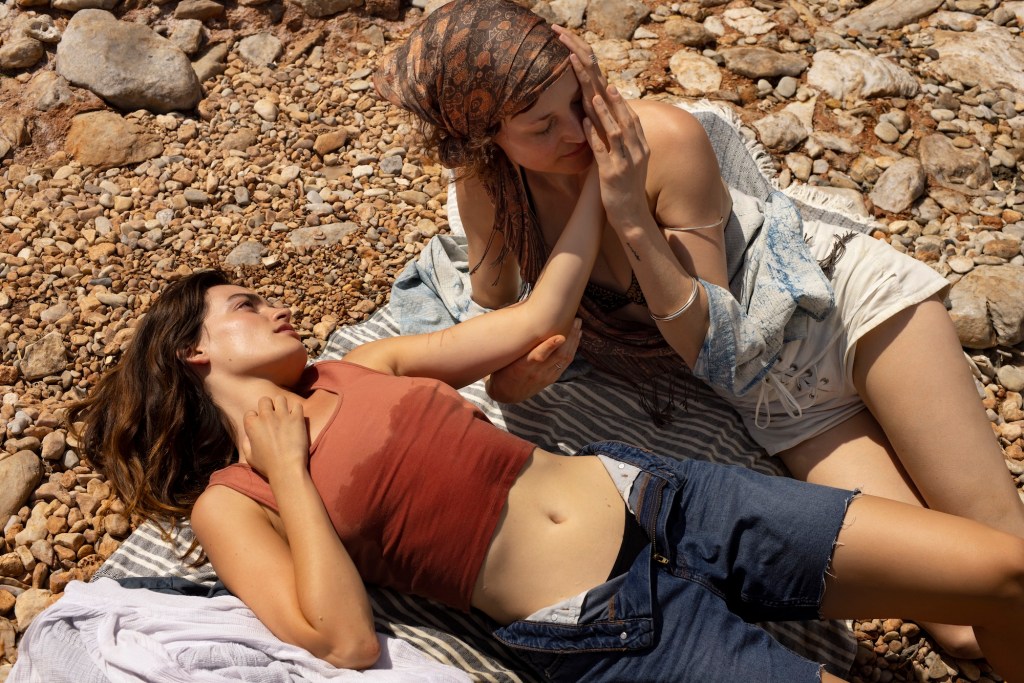
    Essentially this a is a stirring, Irish family drama, but set in the searing heat of the Mediterranean sun, specifically in Almería on the southeastern coast of Spain. Here 25-year-old Sofia (Emma Mackey) has accompanied her wheelchair-bound mother Rose (Fiona Shaw) in her search for a cure for her unexplained paralysis, at the clinic of expensive private consultant Dr Gómez (Vincent Perez).

    Whilst her mother undergoes treatment, Sofia hangs out on the beach, perhaps seeking a cure for her own rather different paralysis, as she waits for her life to properly begin. And she finds it, quite literally, in the hands of Ingrid (Vicky Krieps), a sexy, sensual bohemian who has made this small town her home. But Sofia’s sexual awakening is continually interrupted, partly by the demands of her cantankerous mother and partly by Ingrid’s other dalliances. In search of answers, she takes a trip to see her father (Yann Gael) in Athens, who left when she was just 4-years-old and who she has not seen for 11 years. But all she finds are more questions, and when she returns to Spain she discovers Ingrid also entertains ghosts from her past.

    As you have probably gathered, this is a film about paralysis – about not being able to move forward because past events are always there to prevent progress. The journey is interesting, the characters are extremely well-drawn, the acting is all very good, especially Fiona Shaw who is exquisite as Rose. However, for me the ending failed on so many different levels it was just ridiculous. It did not exactly spoil the film, but left it feeling incomplete.

    Hot Milk is moving, and sad, and I think worth watching, if ultimately not quite satisfying. I wouldn’t rush to see it, but if it is on the TV and you were going to stay in anyway and your hair doesn’t need washing, there are worse ways to spend your time.

  • My ‘Top 3 and a Bit’ Erotic Thrillers

    Just over a month ago, when I posted my last Top 3 and a Bit list, I said that my next list-post would be on Erotic Thrillers. After a month of watching these, many of which proved to be utterly dire, and a fair bit of reading around the subject (The Erotic Thriller in Contemporary Cinema by Professor Linda Ruth Williams, who turns out to be critic Mark Kermode’s better half), I think I am finally ready to put all this behind me. So, here goes…

    As this is the first list I have done based on a specific genre, I thought some definitions might be in order. So, what is a genre?  “A film genre is a stylistic or thematic category for [films] based on similarities either in the narrative elements, aesthetic approach, or the emotional response to the film” (thank you, Wikipedia). In other words, similar themes, similar styles and a similar audience reaction.

    So what is an erotic thriller? “The erotic thriller is a film subgenre defined as a thriller with a thematic basis in illicit romance or sexual fantasy.” Though exact definitions vary, it is generally agreed “bodily danger and pleasure must remain in close proximity and equally important to the plot. Most erotic thrillers contain scenes of softcore sex and nudity, though the frequency and explicitness of those scenes can differ from film to film.” (thank you again, Wikipedia).

    And in the interests of completeness, erotic means “relating to or tending to arouse sexual desire or excitement”. So, ‘tending to arouse’ – i.e. the feather, not the whole chicken!

    Now there are potentially an enormous number of films that fit this definition and as there are only so many hours in the month, I used various published lists to come up with a shortlist of some 70 films to watch. These included lists from Rolling Stone, Time Out and SlashFilm, whatever the hell that is. Some of these are what are known as Genre Films (commercial films which are made specifically to be erotic thrillers) and others are more arthouse films, usually more character driven, which are best classed as thrillers which are also, by their nature, erotic. I included both these types of film in my list, although it is clear that, for some, only the Genre Films fit the category. However, it was also clear from the outset that the Genre Films were going to get a bit samey and that the arthouse films were necessary in order to keep the process interesting.

    So, here are my Top 3 Erotic Thrillers, together with notes on several additional films which are certainly worthy of attention:

    (1)        Elle (2016 – Paul Verhoeven)

    Michèle Leblanc (Isabelle Huppert), CEO of a successful video game company, is brutally raped in her Paris home by a man in a ski mask. Afterwards, she cleans up the mess, bins her clothes and orders a takeaway. An unimaginably traumatic event from her past prevents her from reporting the incident to the police. She is matter-of-fact and uncompromising in all of her relationships and in everything she does, which causes friction wherever she goes. However, despite her initial response, the rape has hit her hard and she goes down a dark and dangerous path which blurs the lines between revenge and consent. The film is very plot-heavy and in the hands of a lesser actress (and indeed a lesser director) it could have been a spectacular failure. However, Huppert gives an astonishing performance, and despite the utterly amoral nature of Leblanc, Huppert makes her not only a believable character, but also a sympathetic one. The film won 15 Best Foreign Language Film awards and Huppert won a staggering 26 Best Actress awards, including the César.

    (2)        The Handmaiden (2016 – Park Chan-wook)

    In Japanese-occupied Korea, a con man “Count Fujiwara” (Ha Jung-woo) plans to seduce a Japanese heiress named Lady Hideko (Kim Min-hee), marry her and then commit her to an asylum to steal her inheritance. He hires a pickpocket named Sook-hee (Kim Tae-ri) to become Hideko’s maid and encourage Hideko to marry him. But in Park Chan Wook’s exquisite adaptation of Sarah Waters’ 2002 novel Fingersmith, nothing is ever quite what it seems. The film is in three parts, telling the story from three different perspectives and as layer after layer of truth and half-truth are peeled away the real story is gently teased out. I first came across Park Chan Wook through his 2022 thriller Decision to Leave, which so impressed me I worked back through his earlier work – he rarely puts a foot wrong.

    (3)        Swimming Pool (2003 – François Ozon)

    Sarah Morton (Charlotte Rampling), an English novelist, goes to stay at the holiday cottage of her publisher, John Bosload (Charles Dance) near Lacoste in France. Here she hopes to find peace and inspiration for her next crime novel. But her quiet is disrupted by the arrival of Bosload’s daughter, Julie (Ludivine Sagnier), whose noisy, messy life consists of drinking, partying and bringing home men for sex. The two do not get on – they are polar opposites – but an uneasy truce develops between them and whilst not wholly embracing Julie’s lifestyle, Sarah dips her toe in the water. However, matters get a little out of hand… The film received very positive reviews and top-critic (and my personal hero) Roger Ebert said: “Ozon … understands, as Hitchcock did, the small steps by which a wrong decision grows in its wrongness into a terrifying paranoid nightmare” – praise indeed!

    And the Honourable Mentions …

    The following films are those that came close to making my Top 3, but did not quite get there (the ’bit’), listed in alphabetical order:

    Basic Instinct (1992 – Paul Verhoeven)

    This is one of the best known of all the Genre Films, from the erotic thriller ‘dream team’ of Verhoeven, Eszterhás and Douglas (not a firm of solicitors). Catherine Tramell (Sharon Stone) is a crime novelist who becomes the prime suspect in the sex-related murder of her boyfriend, in a manner detailed in advance in one of her published novels. Maverick detective Nick Curran (Michael Douglas), who is seeing police psychiatrist Dr. Beth Garner (Jeanne Tripplehorn) in relation to a previous ‘misdemeanour’, investigates the crime. However, the whole situation is complicated by the unhealthy relationship that develops between Tramell and Curran. The premise sounds rather cliched, but it certainly works. However, it is perhaps best known for ‘that picture’ of Sharon Stone’s private parts and for Joe Eszterhás being paid $3 million for the script – at that time a record fee – rather than for the quality of the film itself.

    Bitter Moon (1992 – Roman Polanski)

    Nigel and Fiona Dobson (Hugh Grant and Kristin Scott Thomas) are on a cruise ship on route to India, ostensibly to rejuvenate their flagging marriage. They befriend a beautiful, but clearly damaged, young French woman, Mimi (Emmanuelle Seigner), and later meet her much older, disabled American husband Oscar (Peter Coyote), a cynical, failed writer. Oscar takes advantage of Nigel’s fascination with Mimi to trap him into hearing the story of his strange and twisted relationship with his wife. Whilst Oscar’s tale is lurid and obscene, neither Nigel nor the audience can look away – one just has to know what happens next. And Polanski, who proved his thriller credentials with the earlier Chinatown, is right there with an ending that takes everyone by surprise.

    Body Heat (1981 – Lawrence Kasdan)

    Inspired by the archetypal 1944 film-noir Double Indemnity, this is a classic of the Genre. In the Southern Florida heat, Ned Racine (William Hurt), a low-rent lawyer, begins an affair with married Matty Walker (Kathleen Turner). But her rich shady-businessman husband Edmund Walker (Richard Crenna) stands in the way of their happiness, or at least he stands in the way of her freedom and all of his money. Since divorce is not an answer (they signed a pre-nup agreement) there can be only one way out. This was Turner’s breakout film, and she is perfectly cast in the role of Femme Fatale. With great supporting roles for both Ted Danson and Mickey Rourke, this could hardly fail to be a hit.

    Damage (1992 – Louis Malle)

    This is described by Wikipedia as a romantic psychological drama – it is certainly much more erotic than romantic and with a tight script by David Hare, (adapted from the 1991 novel by Josephine Hart) and in the safe hands of Louis Malle, it proves an intriguing thriller. Dr Stephen Fleming (Jeremy Irons), a government minister, begins a steamy affair with a beguiling, but rather damaged, young French woman, Anna Barton (Juliette Binoche). Unfortunately, she is also the girlfriend of his son Martyn (Rupert Everett). The stellar cast is completed by Miranda Richardson, playing Stephen’s loving wife Ingrid. As Anna’s relationships with both father and son develop, something is bound to go wrong, and when it does, it is certainly dramatic. Irons and Binoche both picked up acting awards, however it was Richardson who won most plaudits, taking three Best Supporting Actress awards, including the BAFTA.

    Fatal Attraction (1987 – Adrian Lyne)

    No list of erotic thrillers would be complete without this, the one that sparked the naming of the genre, and gave us the rather interesting cliché bunny boiler. Attorney Dan Gallagher (Michael Douglas) cheats on his wife with a colleague, Alex Forrest (Glenn Close). He clearly intends this as a one-night stand, but the sex was really wild and exciting, and so he allows himself to be enticed back for seconds – after all, his wife is away for the weekend, so what’s he got to lose? However, when the weekend comes to an end, and he tells her it is all over, it seems she has other ideas.  As he tries to distance himself from her, she becomes more and more clingy and dangerous. The storyline might feel a little hackneyed now, but it didn’t then, and at the time it was a main topic of conversation at all the smart dinner parties (apparently).

    Gone Girl (2014 – David Fincher)

    When Nick Dunne (Ben Affleck)’s wife Amy (Rosamunde Pike) suddenly disappears, he quickly becomes the prime suspect. Did he kill her and hide the body? Or has she been kidnapped? Or has she really just walked out on her marriage? The story is told in three distinct parts, each from a different perspective. The first two stack up reasonably well and are believable, however for me the third was just a little too far-fetched, although it did provide an interesting role for Neil Patrick Harris. The script is by Gillian Flynn, based on her 2012 bestselling novel (which famously Barack Obama mentioned as one of his favourite reads). Somehow, however, the plot twists make this more amusing than suspenseful. When it was first released, I saw it at a small London cinema – just me and a drunken hen party, who roared with laughter throughout – perhaps that has forever coloured my view of it.

    The Housemaid (2010 – Im Sang-soo)

    This is the second South Korean film on my list and is a remake of Kim Ki-young’s 1960 film of the same name, which sadly I have not yet managed to locate. Eun-yi (Jeon Do-yeon) takes a job as a housemaid for an upper-class family. The husband Hoon (Lee Jung-jae) is a hugely powerful businessman; his stay-at-home wife Hae-ra (Seo Woo), already the mother of a little girl, is heavily pregnant with twins. Perhaps predictably, as Hae-ra ceases to give him what he wants sexually, Hoon turns to the naïve, but rather enticing, Eun-yi for his pleasures. However, the ever-watchful Mrs Cho (Youn Yuh-jung) sees all, and reports the affair to Hae-ra’s mother, who gallops in to save her daughter’s marriage. This is almost a proper old-fashioned thriller, with echoes of Hitchcock, right up until the absolutely astonishing ending!

    In the Cut (2003 – Jane Campion)

    So far as I am aware, this is Campion’s only thriller, which she also co-scripted with Susanna Moore, who wrote the novel from which it was adapted. English teacher Frannie Avery (Meg Ryan) witnesses a girl giving head to a NYC cop in the cellar bathroom of a downtown Manhattan dive-bar. Despite the seediness of this, she is clearly intrigued and just a little excited by what she sees. Then the girl then falls victim to a serial killer who has been plaguing the area for a little while. Frannie begins a relationship with an NYC Cop, Malloy (Mark Ruffalo), who is investigating the murders. But a tell-tale tattoo suggests that maybe he was the cop in the bathroom, which might mean he is also the serial-killer? What could have been a fairly run-of-the-mill thriller is lifted by Meg Ryan’s excellent nuanced performance in the lead role, and Campion’s tight direction.

    Knife in the Water (1962 – Roman Polanski)

    Roman Polanski’s only Polish language feature to-date, this was recognised by Martin Scorsese as one of the masterpieces of Polish cinema and nominated for the Academy Award for Best Foreign Language Film – not bad for his first full-length picture. Andrzej (Leon Niemczyk) and Krystyna (Jolanta Umecka) are driving to a lake, when they come upon a young man (Zygmunt Malanowicz) hitchhiking in the middle of the road. They stop to give him a lift and convince him to join them for a weekend’s sailing. However, Andrzej’s constant need to demonstrate his superiority quickly turns the outing into a battle of wills between the two men, with bikini-clad Krystyna looking on, sometimes excited, sometimes disgusted. Polanski, who also co-wrote the screenplay, demonstrated from his very first film that he understood innately just how to build suspense.

    The Last Seduction (1994 – John Dahl)

    Bridget Gregory (Linda Fiorentino), a ruthless telemarketing manager in New York City, walks out on her job and leaves her husband Clay (Bill Pullman), stealing his money in the process. She drives off into the sunset, but only gets as far as Beston, a small town near Buffalo. She allows herself to be seduced by local boy Mike Swale (Peter Berg) and they begin a sexual relationship, but it is clear from the beginning that she is just using him. Then, when it seems likely that her husband may have tracked her down, she ups the stakes. Fiorentino’s performance as the femme fatale is exceptional, and garnered much acclaim, generating talk of an Oscar nomination, however she was deemed ineligible because the film was shown on television before its cinema release. 

    Matador (1986 – Pedro Almodóvar)

    Diego Montes (Nacho Martínez) is a former bullfighter, forced into early retirement after being gored, who now acts as a bullfighting instructor. Among his students is Ángel (Antonio Banderas), a diffident young man who suffers from vertigo. One day Ángel attempts to rape Diego’s girlfriend, Eva (Eva Cobo). Racked with guilt he hands himself in to the police, but she refuses to press charges. In order to assuage his guilt, he admits to two murders which he believes Diego committed. He is appointed a defence lawyer, María Cardenal (Assumpta Serna), who is obsessed with Diego. And it turns out that both Diego and María are both completely obsessed with death. A pretty standard build-up for an Almodóvar film, perhaps, but his usual colourful, stylish visuals together with the straight-faced conviction of the excellent cast make this a truly gripping and exciting thriller.

    La Piscine (1969 – Jacques Deray)

    La Piscine – doesn’t that mean Swimming Pool? We’ve already had that! Yes, but this is a different one. And just to make it more complicated, whilst they are in no way connected and have totally different subject matters, both are French, and both were released as La Piscine in France and as The Swimming Pool in England.

    Jean-Paul (Alain Delon), a writer, and Marianne (Romy Schneider), his girlfriend, are holidaying at a friend’s villa near Saint-Tropez. Harry (Maurice Ronet), an old friend who was Marianne’s lover before Jean-Paul, arrives for a visit, surprising the couple by bringing along his 18-year-old daughter Penelope (Jane Birkin). Harry still has designs on Marianne, and Jean-Paul becomes jealous, although he has a similar interest in Penelope, who interestingly has no love for her father. As the temperature rises, so the temperatures rise (see what I did there), with tragic results. This is a very gentle thriller, but it is certainly an erotic one, with all the sexual mores of the swinging sixties displayed for all to see.

    Rendez-Vous (1985 – Andre Techine)

    Nina (Juliette Binoche, in her first starring role) is a young provincial actress, newly-arrived in Paris, and not getting many offers of work. She is sleeping around, both literally and metaphorically, as she searches for a flat of her own, but with very limited resources. Her estate agent Paulot (Wadeck Stanczak) falls for her and offers her a place to stay, but it is his flatmate Quentin (Lambert Wilson) who she falls into a mutually destructive relationship with. Quentin was due to play Romeo in a production that should have been staged the previous year in London, but had to be shelved after the untimely death of the actress due to play Juliette. The production was to be directed by Scrutzler (Jean-Louis Trintignant) who shows up unannounced in Paris, ready to attempt to resurrect the play. The film is a lyrical exploration of love and loss and of reality and fantasy, which won a Best Director award for Techine at Cannes.

    Sea of Love (1989 – Harold Becker)

    New York City homicide detectives Frank (Al Pacino) and Sherman (John Goodman) team up to track down a serial killer who is preying on guys who have placed poetic, lonely-hearts ads in a local newspaper. They undertake a sting operation by placing their own ‘poetic’ ad in the paper. However Frank, a burned-out alcoholic whose wife left him for a colleague, falls in love with a potential suspect, Helen (Ellen Barkin), which complicates matters somewhat. As Frank falls deeper and deeper in love, more and more clues emerge suggesting Helen is the serial killer. This was the film credited with resurrecting Pacino’s flagging career (his first film since Revolution had spectacularly bombed four years earlier). It is not great, but it is certainly worth watching for Pacino alone.

    I feel sure that I will have offended someone (probably Mark Kermode and the Professor) by including non-genre films in my list, so here are my Top 3 Genre Films, just for the record:

    (1)           Body Heat

    (2)           Basic Instinct

    (3)           In the Cut

    And the rest…

    So, what else did I watch in compiling my list? The following films were also considered, but did not make the grade, many by a country mile:

    L’Amant Double, Body Double, Bound, Dead Ringers, Fair Play, Jagged Edge, No Return, No Way Out, Poison Ivy, Presumed Innocent, Single White Female, Sliver, Unlawful Entry, Wild Things and quite a few more, that do not even deserve entering in the list of not very good stuff.

    Incidentally, I also watched Indecent Proposal, which I had never seen before, and rather enjoyed it, but it is more of a rom-com or drama than a thriller, so didn’t qualify.

    I know I have missed loads of Erotic Thrillers; however I really do need a rest from them now. If you have any films you really think I have to watch (i.e. that may deserve a place in my ‘Top 3 and a Bit’) please let me know. I will endeavour to find them and watch them … eventually … when I leave the darkened room I am about to retire to!
  • REVIEW:  The Ballad of Wallis Island ★★★★☆

    The Ballad of Wallis Island is a new British comedy-drama, written by Tim Key and Tom Basden, based on their 2007 short film The One and Only Herb McGwyer Plays Wallis Island, and directed by James Griffiths. It premiered at the Sundance Film Festival in January and was released in the UK on 30 May. 

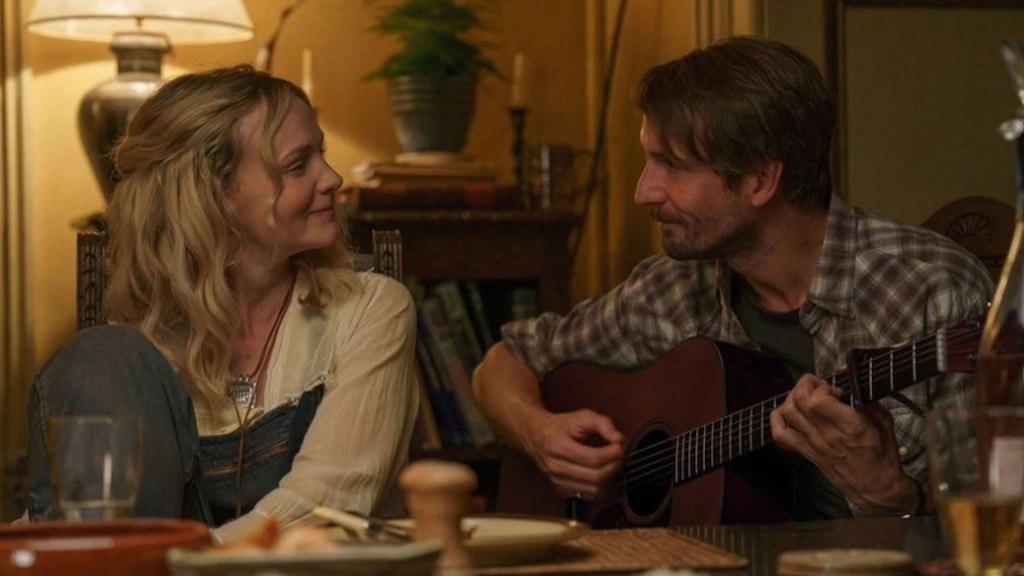
    Eccentric lottery-millionaire Charles Heath (played wonderfully awkwardly by Tim Key) lives as a virtual recluse on the remote Wallis Island. There have been two major passions in his life: his wife, Marie, who died five years previously; and the folk duo McGwyer Mortimer, who Charles and Marie loved, but who had split up around the same time.

    At the beginning of the film, Herb McGwyer (Tom Basden) arrives on the island on a small boat, ready for the concert he has been booked to play. He is met by Charles, who takes him to his house to settle in and prepare himself for the ‘small’ gig. Clearly something is amiss. Herb is uncomfortable with his host’s continual questioning about the McGwyer Mortimer days – he is now a solo artist and wants to concentrate on his new style. And then Nell Mortimer (Carey Mulligan) arrives, husband in tow, ready to play ‘their’ concert.

    It is clear that they have been told different things, and they are being paid different amounts for the gig, however their motivations for accepting were the same. They both need the money: Herb needs to finance his next solo album with a view to resurrecting his flagging career; Nell, who has given up the music business and is making and selling Chutney in farmers markets in Portland Oregon, simply needs cash.

    And so the stage is set. Well actually, it isn’t. There isn’t really a stage. In fact there isn’t really a venue – just a pebble beach. And there isn’t really an audience – just Charles.

    This is a film about looking back on something that once was, but can never be again, and the need to move forward in life. In some ways, all three of the main characters stopped, or at the very least faltered, five years previously. It is a film about love and loss. And ultimately, it is a film about hope.

    This is not a laugh-out-loud comedy, although there are some very funny moments. It is a film about broken people, each trying to find a way forward. I very much enjoyed the music; I enjoyed spending time with these three people; and the rather sentimental ending was perfect!

    The Ballad of Wallis Island is funny, and sad, and ultimately a very rewarding watch. Go see it!

    (Incidentally, if you are interested in seeing the original 25-minute short that inspired the film, click here, but if I were you I would watch the full film first).