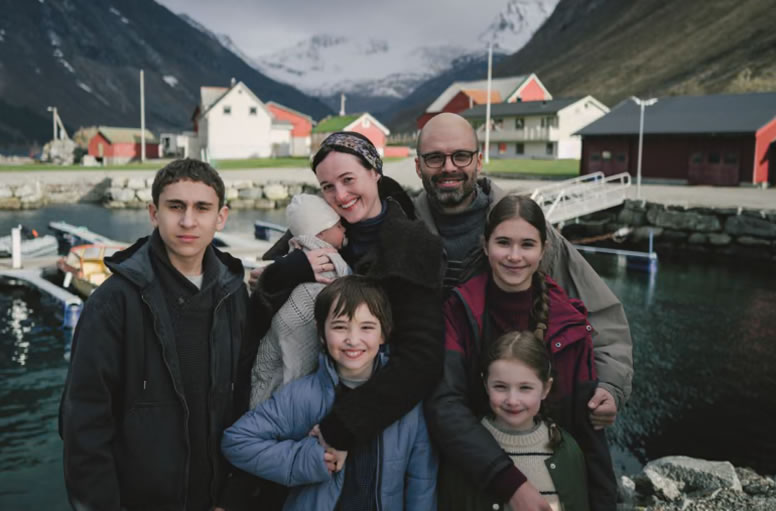
Fjord is a 2026 family legal drama written and directed by Cristian Mungiu. The film had its world premiere at the Cannes Film Festival in May, where it won five awards, including the Palme d’Or, making the Romanian director only the tenth person to win the award twice (assuming you count the Dardenne Brothers as one person). It went on general release in the UK last Friday, 13 November.
Romanian engineer Mihai Gheorghiu (Sebastian Stan) and his Norwegian wife Lisbet (Renate Reinsve) are devout evangelical Christians who have recently moved with their five children from Romania to Norway to be closer to Lisbet’s family following the death of Mihai’s parents. Their new next-door neighbours are Mats Halberg (Markus Tønseth), the headmaster at the local school; his wife Mia (Lisa Carlehed), an attorney; and Noora (Henrikke Lund-Olsen), his somewhat unruly daughter from a previous marriage. The eldest Gheorghius’ children, Elia (Vanessa Ceban) and Emmanuel (Jonathan Ciprian Breazu), become good friends with Noora, which seems to have a calming influence on her. Then a teacher at their school notices bruises on Elia’s body during a physical education class, and, suspecting child abuse, reports the Gheorghiu family to Child Welfare Services. Then, inexplicably, with no investigation and virtually no real evidence, the five children are taken into care, and the parents are charged with child abuse. I say inexplicably, not because I doubt the veracity of the story, which is based on real-life events concerning the Bodnariu family, but because for a local authority to have such power is, to me, bizarre in the extreme. What follows is the Gheorghius’ struggle to reunite their family, which is utterly fascinating, becoming a battle between the ultra-progressive Norwegian child welfare laws and the traditional family values of the ultra-devout evangelical Christian family.
This film does not over-sensationalise the issues but lets the story play out in its own time. There are a number of subplots concerning, amongst other things, a potential blossoming lesbian relationship and the right of an older person with a poor quality of life to die with dignity. However, it is the clash of cultures relating to the custody of the children which is the main story. Mungiu’s screenplay is excellent, as is his direction, and in addition to his well-deserved Palme d’Or, he has been nominated in both categories in the forthcoming European Film Awards. Renate Reinsve is excellent, but when isn’t she, and so was Sebastian Stan, who was something of a revelation to me – I confess I did not even know the name, yet I have seen a half dozen or so of the forty or more films in which he has appeared. The rest of the cast, particularly the three elder children, were all very credible in their roles. The cinematography was also terrific, but what do you expect with the spectacular backdrops of the Norwegian fjord.
I don’t want to comment on the rights and wrongs of the argument, except to ask how can it be right that a seven-year-old can declare her sexuality in the classroom, but another cannot express her religious beliefs? And for balance, is it really right in this day and age to ban teenage children from having mobile phones, listening to modern music and watching YouTube videos?
Fjord is an important film, dealing as it does with the danger of progressive societies becoming too powerful, and it is beautifully realised. If you can get to see this at the cinema, I would strongly recommend it.


Leave a Reply