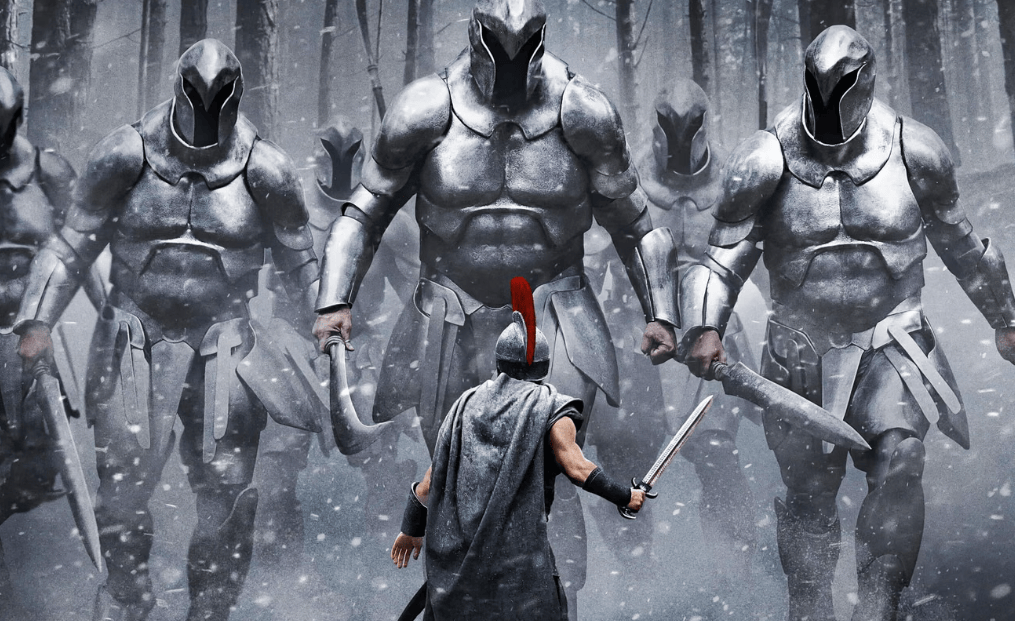
The Odyssey is a 2026 epic action fantasy film written and directed by Christopher Nolan. It is based on Homer’s epic poem, apparently utilising Emily Wilson’s translation. It had its world premiere at the Odeon Luxe Leicester Square in London in early July and went on general release shortly thereafter. It was released in the UK on Friday, 17 July.
I know this seems like a bit of a cop-out, but I have been to see several films this year knowing I would not like them, and the idea of sitting through three hours of this was a step too far. I do not like action films; I do not really like fantasy films; and the trailer left me totally bored. I have read countless reviews, many of which are very positive, however the one that seems most in tune with my thoughts on adapting great literature are those of Emily Wilson in the London Review of Books (https://www.lrb.co.uk/the-paper/v48/n14/emily-wilson/an-uncomplicated-man).
However, it seems too big of a cinema event to miss it completely, and my son, who has seen the film and is a poet himself, offered to write a review for me. So here it is:
GUEST REVIEW – BY ALEX BICKLEY
In his first film since Oppenheimer (2023), Christopher Nolan has taken on perhaps the most famous poem of the ancient era, if not of all time, the various episodes of which are known to millions even if they haven’t read the work itself. This is a formidable task for any filmmaker, as they are dealing with an audience who all have their own contradictory ideas as to what the story is.
The Odyssey is the story of Odysseus’s (Matt Damon) ten-year return to his home on the island of Ithaca, and the various challenges he and his men face along the way. Odysseus had, before the start of his journey, been at war, fighting with his fellow Greeks against the Trojans. This war also took ten years, and so by the time he returns (20 years after he left), his presence on the island is merely a distant memory; his son, Telemachus (Tom Holland) does not remember his father, and his wife, Penelope (Anne Hathaway), barely does. In fact, as Odysseus struggles at sea, so does his family at home, forced to be hospitable to Penelope’s many suitors, attempting to convince her to remarry, on the basis that her husband must now be long dead. Having returned to the island, incognito, the final third of the poem involves Odysseus’s overthrowing of the suitors and reuniting with his wife.
Though in effect a sequel, The Odyssey (c. 800 BC), due to its adventure story structure, is the more well-known of Homer’s poems, and it is not uncommon for artists, like Nolan, to adapt it standalone, ignoring The Iliad, or rather, in Nolan’s case, not quite ignoring it. And this is perhaps where the issues began: Nolan’s opening montage, of around half an hour, attempts to cover much of the content of The Iliad (being the story of the war with the Trojans), the poem to which The Odyssey is a sequel, in an attempt to explain what needs to be explained. However, such is the nature of complex mythologies, half an hour is enough time to merely complicate. Thus, by the end of the first half-hour, having neither sufficiently set up the story (as a prologue) nor properly begun it (as an opening chapter or act), I felt the film had no idea where it was going.
And so, then, eventually the story of Odysseus’s return begins.
The various obstacles that Odysseus and his men face along the way are, to give Nolan his credit, the strongest sections of the film. Nolan is a maker of superhero films, and the central third of the story is a series of heroic stories, of good guys fighting bad ones. A purist like me will mourn the loss of some plot points, such as the conversation that Odysseus has with the cyclops Polyphemus (Bill Irwin), and of Aeolus and the bag of winds. I think that essentially Odysseus is a little cleverer than Nolan allows him to be, and that a lot of what is omitted would have highlighted his ingenuity over his physical prowess.
And then, there’s the ending.
I have to admit I was quite angry by the end of this film. The person I saw it with, who enjoyed it (a little), said I should have taken the film as it was, and that I shouldn’t mind things being ‘changed a bit’, but the problem with the ending – and I’m going to avoid spoiling the ending, because, unlike the rest of the film, it isn’t almost 3 millennia old and thus unspoilable – is that the changes to Homer’s plot are so seismic that they totally alter the character of Odysseus, removing all of the light and shade, and making him, basically, all-round good, flat, and bland.
Homer’s poem, in the recent, critically-acclaimed translation by Emily Wilson, begins ‘Tell me about a complicated man.’ The word Homer uses is πολύτροπον – Wilson translates this as ‘complicated’, more literally it might be ‘of many shifts’, ‘multi-dimensional’, etc. – not simply good or simply bad. And Nolan’s ending removes this entirely.
There are moments of this film where the greatness of the original story breaks through, but they are few and far between. The first and last forty-or-so minutes are irritating in the extreme. When it comes to Odysseys, I would personally either recommend reading it (Wilson’s translation is very good, as is E. V. Rieu’s), or if you wish for a dramatisation, Simon Armitage’s 3-part radio version is wonderful (The Odyssey (2004) starring Tim McInnerny).
But this film, I cannot endorse. The adaptation has rendered an epic poem neither epic nor poetic. I expected from Nolan the total lack of poetry, but I did not expect, given his many years in the profession, the poor cinematic craftsmanship. By attempting to squeeze an Achilles-less Iliad within the first act of the Odyssey and then introducing an erroneous subplot into the last act, Nolan has upset the balance of a tale by one of the masters of storytelling, the result of which is a total mess.
In addition to the review, Alex wrote a poem relating to his experience of the film, which feature on his poetry blog: https://abickleypoet.wordpress.com/2026/08/11/homoeronic-a-poem-in-response-to-christopher-nolans-the-odyssey-2026/


Leave a Reply