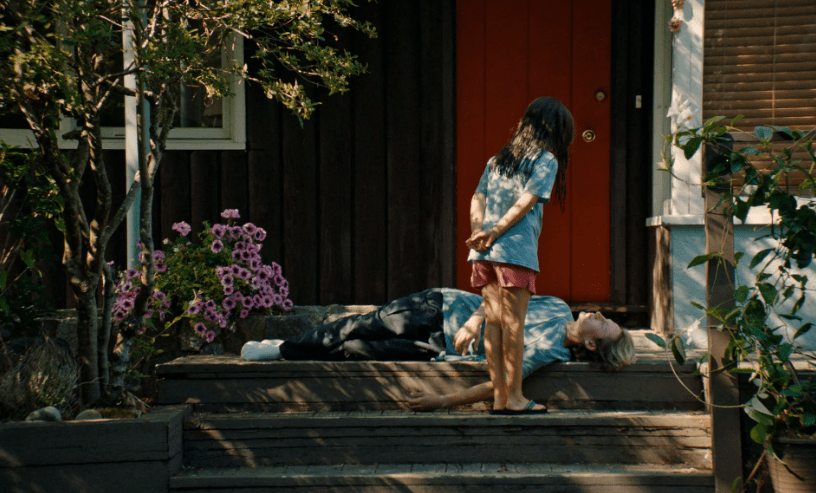
Blue Heron is a 2025 Canadian ‘memory drama’, written and directed by Sophy Romvari in her first full-length feature. It is semi-autobiographical, loosely based on her own childhood and her previous short film Still Processing. It had its world premiere at the Locarno Film Festival in Switzerland last August and was released in the UK on 26 June.
Blue Heron tells the story of a family torn apart by the behaviour of the eldest son, Jeremy (Edik Beddoes) whose behaviour is at best extremely disruptive to family life and at worst potentially dangerous to himself and those around him. Originally from Hungary, his Father (Ádám Tompa) and Mother (Iringó Réti), neither named, have recently relocated their family to Vancouver Island. Jeremy is the son of Mother from a previous relationship; they have three other children: Henry, Felix and Sasha (Eylul Guven).
For the first half of the film, we watch the family in the 1990s getting to know their new surroundings and trying to cope with the ever more disturbing behaviour of Jeremy. It is rather wonderful in its attention to detail and its focus on the ordinariness of the world around them, although it has a certain dreamlike quality, neatly implying the fallibility of memory. One particular touch I liked was that the parents revert to speaking Hungarian when they do not want the children to understand what they are saying. What comes across terrifyingly is the power which Jeremy (perhaps unwittingly) wields and the total impotence of the parents.
I think I would have liked the film to carry on in the same vein, however it doesn’t. Half-way through there is a disconnect, and we begin to see the story from the perspective of the older Sasha (Amy Zimmer) as she tries to come to terms with her memories of what happened and tries to process how she feels about these memories. I have heard the term guilt used here, and personally I cannot see how the pre-teen Sasha should feel any guilt, nor any of the family for that matter however, perhaps that is the nature of guilt: it is an emotional response, not a rational one. Whilst I understand that this process is vital to Romvari in coming to terms with her feelings relating to her own childhood, particularly the failure of the support mechanisms in place thirty years ago, I think it detracts slightly from the power of the storytelling. I wanted to see a little more and be told a little less.
Blue Heron is a strange blur of reality and memory, a deeply personal experience for the filmmaker but also a relatable yet devastating drama. I have no hesitation in recommending this film. I think Romvari is clearly a talent to watch and I believe that, once relieved of the constraints of her own story, she will blossom as a filmmaker.


Leave a Reply