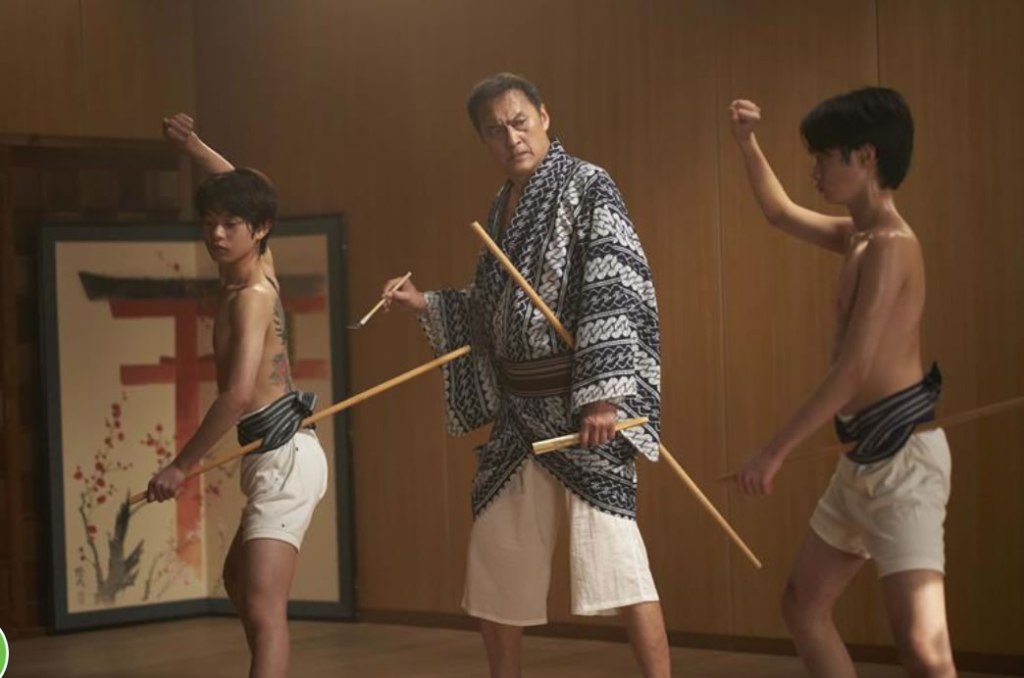
Kokuho (literally – ‘National Treasure’) is a 2025 Japanese historical drama film directed by Lee Sang-il and written by Satoko Okudera, based on the 2018 novel Kokuho by Shuichi Yoshida. It had its world premiere at the Cannes Film Festival last May, was a box-office sensation in Japan and was finally released in the UK on 8 May.
Kokuho is epic, both in terms of its fifty-year timespan and its astonishing ambition. The original novel was over 800 pages, and the initial cut of the film ran four and a half hours, so had to be cut by around one third. The film tells the story of a rivalry and friendship between two boys lasting some forty years, whilst providing an insight into the single-mindedness required for artistic excellence and giving an introduction to, and basic education in, the ways of Kabuki.
It begins in 1964, where Kikuo Tachibana (Ryo Yoshizawa), son of a yakuza boss, performs an onnagata role at a New Year gathering in Nagasaki. (An Onnagata is a male actor who specializes in playing female roles in kabuki theatre.) This is witnessed by Hanai Hanjiro II (Ken Watanabe), a kabuki master, who is a guest at the party; he sees something special in Kikuo’s performance. At the end of the party, there is an attack by a rival yakuza gang and Kikuo’s father is killed.
A year later, despite his yakuza background, Kikuo is taken on as an apprentice by Hanjiro, and begins training alongside Hanjiro’s son Shunsuke (Ryusei Yokohama); the two form a brotherly bond. As Hanjiro’s son, Shunsuke is destined to take over his father’s title, but when Hanjiro is injured in a traffic accident and unable to perform, he gives his role to Kikuo, causing a schism in the family. Shunsuke disappears and in his long absence Hanjiro decides Kikuo should inherit his title and become Hanai Hanjiro III. However, during the handover ceremony, Hanjiro falls ill and calls out for Shunsuke before he dies. As a result, Kikuo loses support in the kabuki house and is relegated to supporting roles.
Meanwhile, Shunsuke returns to a starring role in a rival kabuki house and Kikuo’s yakuza past and an illegitimate daughter he has sired, further tarnish his reputation. He is forced out of the house and out of kabuki. Four years later, he is making a living performing at banquets when he is offered a chance to return to kabuki; again, he teams up with Shunsuke, this time to great acclaim. However, Shunsuke collapses on set, and later has to have a leg amputated below the knee due to diabetes complications. He expresses his desire to perform the onnagata role in ‘The Love Suicides’, alongside Kikuo, before it is too late. The performance is a great success, but Shunsuke is close to death.
I know I seem to have explained far too much of the plot here, however there is far more to it than these bare bones might suggest. Getting to know the characters is an absolute joy and the journey into their pursuit of artistic excellence at any cost is fascinating. As for the kabuki itself, it is entrancing: the costumes and the performances are wonderfully portrayed and the information provided on screen is sufficient to provide an overall understanding of the art form without being obtrusive.
I strongly recommend Kokuho: it is beautifully filmed and a fascinating story – I now need to get hold of some tickets to see some real kabuki at the Sadler’s Wells Theatre in July!


Leave a Reply