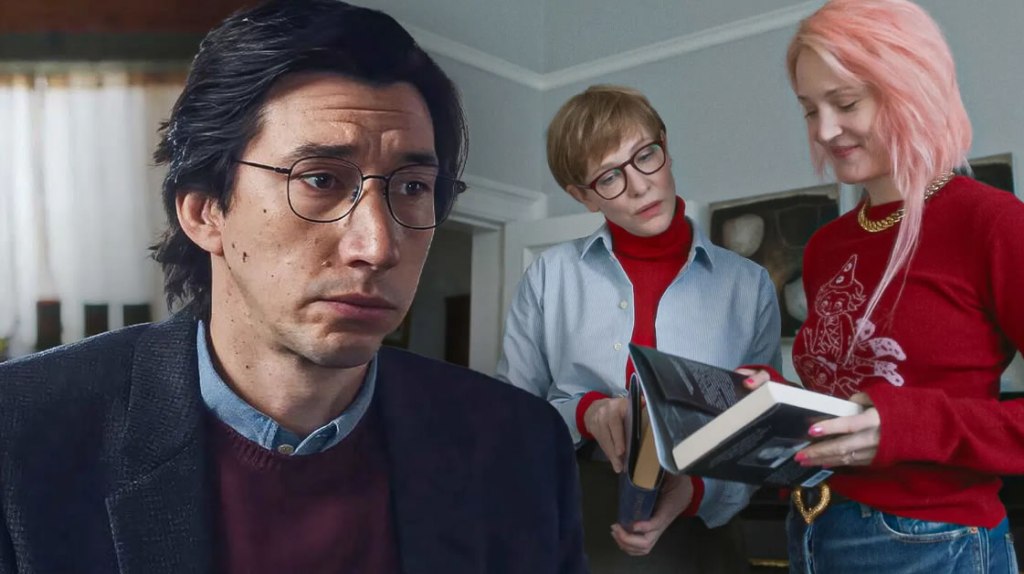
Father Mother Sister Brother is a 2025 anthology drama written and directed by Jim Jarmusch. It had its world premiere at the Venice International Film Festival in August, where it won the Golden Lion, and was released in the UK on Friday, 10 April.
There are three apparently unrelated vignettes in Father Mother Sister Brother, though there are several recurring motifs which provide a link between the pieces (watch out for Rolex, skateboarders and Bob’s your Uncle!) The film is a meditation on the relationships between adult children and their parents; do not come to this expecting plot – Jarmusch is at his best when there is little or no plot; and do not expect the characters to say what is on their minds – let’s face it, few of us do that very often. Just enjoy getting to know the characters and understanding where they are and what must have / might have happened over the years to get them there. Remember, as Philip Larkin put it: “They fuck you up, your Mum and Dad, they may not mean to, but they do.”
The first part of the triptych is Father, played by Tom Waits, whose two almost-middle-aged children, Jeff (Adam Driver) and Emily (Mayim Bialik) pay him a visit in his small rural New Jersey home. The film begins with ‘Father’ apparently tidying the house in preparation for the visit, as the ‘children’ drive down, discussing how their aging father manages to survive on little or no income. It quickly becomes apparent that while Emily has been estranged from her father for quite some time, Jeff has been providing him with considerable financial support over the years.
The second part is Mother, an elderly successful novelist played by Charlotte Rampling, who prepares for her annual tea-party visit from her two daughters, the uptight Timothea (Cate Blanchett) and wild-child Lilith (Vicky Krieps). The daughters are somewhat competitive in their desperation for their mother’s attention/affection; however, they are united in their mocking of her complete lack of maternal instinct. To meet their mother for just a couple of hours a year when they all live in the same small city (Dublin) might seem insufficient contact, however it quickly becomes apparent that any more would be torture for all of them.
At this stage, two thirds of the way in, dare I suggest that the parents are not earning too much of our sympathy and respect.
The final part of the triptych is Sister Brother: Skye (Indya Moore) and Billy (Luka Sabbat), a pair of recently orphaned twins, who pay one last visit to their parents’ apartment in Paris. Here the parents come off a little better, as it becomes clear that however good or bad they may have been as parents, there was a love for and a pride in their children seen through the possessions they left behind. However, there are also items within those possessions which lead the twins to wonder how much they really knew their parents, feelings strengthened by their financial position and the nature of their ultimate demise. There is an wonderful cameo as the housekeeper from veteran French actress Françoise Lebrun, whose filmography reads like a Who’s Who of post-new-wave French cinema.
Whilst I cannot fault any of the acting in the film – they were all extremely good – I have to single out Vicki Krieps, who for me stole the show as Lilith. Whilst the piece has no real plot, Jarmusch’s direction is extremely tight: there is not a slack moment in the whole film; the 111-minute running time seemed to flash by.
I honestly recommend that, if you are either a parent or were once the children of parents yourself(!), then you should see Father Mother Sister Brother. It is great entertainment and perhaps leaves you ruefully contemplating your own relationships.
 Richard Online
Leave a comment