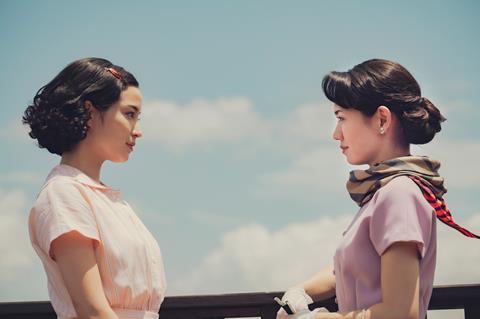
A Pale View of Hills is a 2025 drama film written and directed by Kei Ishikawa, based on the 1982 debut novel of Kazuo Ishiguro. The film is a UK/Japanese/Polish co-production and is part in Japanese and part in English. It had its world premiere at the Cannes Film Festival in May and was released in the UK on Friday, 13 March.
I should start by saying that I am not familiar with the novel. Consequently, I do not know how faithful this adaptation is, either in terms of structure or content.
The film is structured in two interwoven strands: one in English, set in England in the early 1980s (when the novel was written); and one in Japanese, set in Nagasaki in the 1950s (when the key elements of the story take place). It takes the form of a confessional, with Niki (Camilla Aiko) asking her mother Etsuko (Yō Yoshida) to tell her about her life in Japan and about how she came to move to England. The second strand is thus, effectively a series of flashbacks. Here Etsuko (now played by Suzu Hirose) tells of her unsatisfying marriage and of how she met and became friends with an unmarried mother, Sachiko (Fumi Nikaido). There is also a sub-plot concerning her father-in-law and the somewhat gung-ho attitude of the Japanese patriarchy to the Second World War.
My first problem with the film is that the English section feels very stagey. Perhaps that is because, as it is set in the 1980s, it is already in the past, therefore does not feel like the ‘now’ it must have been in Ishiguro’s novel. However, it felt somehow sanitised to the point of being rather twee: when the mother and daughter bumped into other people, they seemed like characters from an Agatha Christie TV adaptation. I found myself waiting for the 1980s bits to end so that we could get back to the real story.
The second thread was much more interesting. The characters were beautifully portrayed by the two lead actresses, and the cinematography was quite wonderful. The stories were much more human and alive. I was particularly taken with the father-in-law, whose relationship with his son brought with it echoes of Yasujirō Ozu’s take on the family.
However, that said, the overall plot did not really work for me. The twist was neither clear nor satisfying and I was left with the feeling that whilst this was a revelation to us, it couldn’t have been to Niki who must have been able to do the maths all along. I understand that the novel is somewhat ambiguous, with Etsuko being an unreliable narrator, however this unreliability did not really come out in the film until the dénouement; I think it would have benefitted from making this more apparent earlier on.
A Pale View of Hills is a curate’s egg of a film – good in parts. The second thread much more real and interesting than the first, but still the ambiguities left me disappointed with the end result. I cannot honestly recommend it, but when it turns up free to watch on your television, maybe take a look.
 Richard Online
Leave a comment