For the last few weeks I have immersed myself in films about films. This meta, rather self-indulgent subject has attracted many of the heavyweight US and European directors over the past seventy years, several of them more than once, although strangely it does not seem to be of much interest to Asian directors.
The actual content of the films varies enormously, covering between them virtually every aspect of filmmaking. The quality also varies enormously, and I have split my Honourable Mentions list into two halves – the genuine contenders and those which, whilst very good, were never really up there.
So, here are my Top 3 Films about Films, together with notes on several additional films which are certainly worthy of attention:
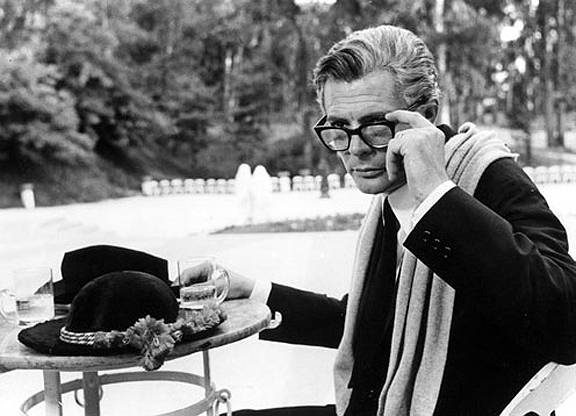
(1) 8 ½ (1963 – Federico Fellini)
8 ½ is a semi-autobiographical film about the creative process. At the time, Fellini had directed 7 other films and co-directed one – hence this would be his ‘eight-and-a-halfth’ film. The protagonist is Guido Anselmi (Marcello Mastroianni), a director suffering from writer’s block, trying to put together his next film. His producer has checked him into a spa for a rest-cure, however he gets little rest; instead, in his mind he constantly runs through all the women who have been significant in his life so far, in search of some kind of inspiration. The film is basically an exploration of the way the human mind works – a combination of observing reality, daydreaming, fantasising, and recalling memories. Since the mind jumps all over the place, so does the film: it has no linear structure. Each time I watch this film, I find something new; it is fascinating and confusing in equal measure. Do not expect it to be easy to understand – just enjoy trying! 8 ½ won the Oscar for Best Foreign Language Film in 1963.
(2) Pain and Glory (2019 – Pedro Almodóvar)
Madrid-based filmmaker Salvador Mallo (Antonio Banderas) suffers from extremely poor health, rendering him unable to work. He is asked to attend a screening of one of his old films, Flavor, which has recently been restored. He has not seen the film’s star Alberto Crespo (Asier Etxeandia) for many years, having fallen out with him over his use of heroine during the filming of Flavor. He visits Alberto, who is still a user, to ask him to co-present the screening with him, and whilst there, bizarrely, he decides to try heroine himself. The heroine triggers long-buried memories of Mallo’s childhood and his route into filmmaking. There is an excellent performance from Penelope Cruz as his mother. Almodóvar draws on his own life in this subtle, yet powerful celebration of filmmaking, which both Time Magazine and the New York Times named best film of 2019. It was nominated for the Best International Feature Film Oscar and won multiple awards for both Banderas and Almodóvar.
(3) Day for Night (1973 – François Truffaut)
This film is about the filming of a melodrama, Je vous présente Paméla, with a largely French cast but an English star, Julie Baker (Jacqualin Bissett) in the title role. Truffaut himself plays Ferrand, the director, and he is reunited with the star of The 400 Blows, Jean-Pierre Léaud, as Alphonse, a young French actor playing Pamela’s husband. Whilst the film gently pokes fun at the self-importance of some of the actors, it also considers whether cinema is more important than life to those who create it. We witness the myriad decisions the director must make every day, and the artificiality of filmmaking: the way it creates the appearance of reality rather than a version of reality. Indeed the title refers to the process of filming outdoor sequences in daylight with a filter over the camera lens to appear as if they are taking place at night. I particularly love the filming of the crowd scenes which bookend the film. Day for Night won the Oscar for Best Foreign Language Film in 1974 and also the BAFTA for Best Film.
And the Honourable Mentions … (1) The Contenders
The following films are those that came very close to making my Top 3, but did not quite get there (thefirst ‘bit’), listed in alphabetical order:
Bergman Island (2021 – Mia Hansen Love)
A romantic drama about a filmmaking couple visiting the island of Fårö, partly as a pilgrimage to the home of Ingmar Bergman and partly as a working retreat. Tony Sanders (Tim Roth), the ‘visiting director’ for the summer programme at the retreat, is confident and successful. Whilst on the island he, seemingly effortlessly, completes his new screenplay. His wife Chris (Vicky Krieps) is less confident and does not have Tony’s track record. As she struggles to develop her screenplay, she shares her ideas with Tony, looking for help and advice, and her film literally comes to life in front of us: a ‘film within a film’, a charming romantic comedy starring Mia Wasikowska and Anders Danielsen Lie. Bergman Island explores the creative process whilst also exploring the cracks in the Sanders’ relationship as they struggle to put together their next projects. There are clear parallels here with Hansen Love’s own relationship with fellow filmmaker Olivier Assayas.
Broken Embraces (2009 – Pedro Almodóvar)
Harry Caine (Lluís Homar) is a blind writer, who shares his life with his agent Judit (Blanca Portillo) and her adult son, Diego (Tamar Novas). Diego is hospitalized after an accidental drug overdose in a nightclub. Harry collects Diego from the hospital and looks after him to avoid worrying his traveling mother. Hearing that his nemesis, millionaire Ernesto Martel (José Luis Gómez), has died, Harry reluctantly tells the recovering Diego the tragic story of his love affair with Magdalena “Lena” Rivas (Penélope Cruz), Martel’s wife. The story, told in flashback, is a tragic Hitchcockian mix of jealousy, abuse of power, betrayal, and guilt. Almodóvar gives us his trademark primary-colours throughout this nouveau-noir thriller, but ultimately something much more sinister lurks just below the surface.
Camera Buff (1979 – Krzysztof Kieślowski)
Set in the late 1970s in Wielice, Poland, humble factory worker Filip Mosz (Jerzy Stuhr) becomes a father and begins filming his daughter’s first days, with a newly acquired 8mm movie camera. His reputation as an amateur filmmaker quickly spreads, and he is asked by the local Communist Party boss to film a jubilee celebration at the factory. His film is selected for a Polish Film Festival and from there he develops a fascination with the possibilities of film, which begins to transform his life. However, his naivety begins to show through, and in seeking artistic success, he risks losing everything he has. One reviewer wrote that “suffused with Kieslowski’s dry wit and intelligence, this early feature provides an excellent introduction to his work” I couldn’t have put it better myself!
Cinema Paradiso (1990 – Giuseppe Tornatore)
Salvatore Di Vita (Jacques Perrin), a famous Italian film director, returns to his home in Rome late one evening to be told that his mother called to say Alfredo has died. Unable to fall asleep, he revisits his childhood and teenage years at the ‘Cinema Paradiso’ in a small Sicilian town, and in particular his relationship with the ageing projectionist Alfredo (Philippe Noiret). Credited with revitalizing Italy’s film industry, and winning the Oscar for Best Foreign Language Film in 1989, Cinema Paradiso has been cited as one of the greatest films of all time. The ending is considered among the greatest endings in film history, so I had best not spoil that.
Contempt (1963 – Jean-Luc Godard)
I should open this paragraph by saying that when it comes to the French New Wave, one is either a Truffaut man or a Godard man; and I am definitely for Truffaut. Having said that, Contempt is a fascinating film and even I can see it deserves a place in this list. Paul Javal (Michel Piccoli), a young French playwright, has been asked to rework the script for Austrian director Fritz Lang’s adaptation of the Odyssey. As Javal and Lang (who plays himself in the film) debate the nature of adapting classics for the screen, producer Jerry Prokosch (Jack Palance), a vulgar American, sets his sights unsubtly on Javal’s wife Camille (Brigette Bardot). Camille looks to her husband for protection, but he is rather preoccupied with the screenplay, leaving her alone and vulnerable. The contempt of the title could refer to Javal’s treatment of his wife, or Prokosch’s treatment of everyone, or possibly even the film producers’ treatment of Godard. Whichever it is, it is well worth watching.
Mulholland Drive (2001 – David Lynch)
Mulholland Drive is described by Wikipedia as a surrealist neo-noir mystery art film – that pretty much covers all the bases. Ever since it was released, there has been much speculation as to what the film is actually about: which characters are real, and which are fantasies created by the real ones. Naomi Watts plays both Betty Elms and Diane Selwyn, and I feel pretty sure that one is real and the other is in the real one’s head. Probably. Laura Harring plays ‘Rita’ and Camilla Rhodes, but again it is not clear what represents reality. This is a hugely confusing film, but also a hugely enjoyable one; the 147 minutes flash by. To me this is David Lynch’s masterpiece and each time I watch it I think I am beginning to understand it. Or not. Either way, once you see it you will want to see it again; it is addictive.
Peeping Tom (1960 – Michael Powell)
Mark Lewis (Carl Boehm) picks up a prostitute, follows her into her flat, and murders her with a blade concealed in one leg of his tripod, all the time covertly filming her with a camera hidden under his coat. Mark works at a film studio. He arranges with Vivian, an actress at the studio, to make a film after the set is closed; he then kills her in a similar manner and hides the body in a prop trunk. He begins a relationship with Helen (Anna Massey), a girl with whom he shares lodgings, and he confides in her about the abuse he suffered as a child at the hands of his father. The police, of course, investigate the crimes. Peeping Tom was praised for its psychological complexity. In his 1999 review of the film, Roger Ebert states that “movies make us into voyeurs. We sit in the dark, watching other people’s lives. It is the bargain the cinema strikes with us, although most films are too well-behaved to mention it”. So there!
Sunset Boulevard (1950 – Billy Wilder)
A corpse is discovered floating in the swimming pool of a mansion on Sunset Boulevard. It is screenwriter Joe Gillis (William Holden). We hear sirens, but a voiceover (Gillis again) tells us that before the police arrive, he will tell us how he met his demise. So we learn how he first came to the mansion of ageing star of the silent screen Norma Desmond (Gloria Swanson); how she employed him to rewrite her screenplay for her comeback movie, Salome; how he began a relationship with fellow screenwriter Betty Schaefer (Nancy Olsen); and how he ended up in that swimming pool. There is a wonderful performance by Erich von Stroheim as Max, the butler, and a nice cameo for Cecil B DeMille as himself. Sunset Boulevard won a shedload of awards, including the Golden Globe for Best Picture, but was pipped to the Oscar by All About Eve.
And the Other Honourable Mentions … (2) Great films, but never really Contenders
The following are great films in their own right, but never really came close to making my Top 3 (the second ‘bit’), again listed in alphabetical order:
Adaptation (2002 – Spike Jonze)
A meta screenplay by Charlie Kaufman (Nicholas Cage) about writer’s block, based on his own struggles to adapt Susan Orlean (Meryl Streep)’s 1998 non-fiction book The Orchid Thief. The film throws up some interesting ideas regarding the conflict in the role of the adaptor between remaining true to the source material and inventing new story to develop a more interesting film. Unfortunately, I felt it was very badly let down by its ending, where it became a pastiche of everything it had set itself out not to be.
The Artist (2011 – Michel Hazanavicius)
A French black and white, silent film set in Hollywood about the difficulties stars of the silent era found when moving into talkies. George Valentin (Jean Dujardin) is the mega-star of the silent pictures who fails to make the leap; Peppy Miller (Bérénice Bejo) is the new girl who falls in love with George, but cannot help her own rise to stardom in the new world of the talkie. A little slight to make the main contender list, but some interesting ideas and a very satisfying film to watch. The film won seven BAFTA awards, including Best Film and Best Actor for Dujardin.
The Aviator (2004 – Martin Scorsese)
Biopic of Howard Hughes (Leonardo DiCaprio), filmmaker and aviation pioneer. In fact, whilst he produced some fifteen films, he only directed two: Hell’s Angels and The Outlaw. He is much better known for his exploits as an aviation pioneer and, perhaps a little unfairly, for his OCD issues and for becoming a recluse. The film has a terrific cast which includes Cate Blanchett as Katharine Hepburn and Kate Beckinsale as Ava Gardner.
Boogie Nights (1997 – Paul Thomas Anderson)
Set in Los Angeles’s San Fernando Valley in the 1970s and 1980s, this is an extension of Anderson’s short mockumentary film The Dirk Diggler Story (1988). It focuses on a young nightclub dishwasher (Mark Wahlberg) with a huge penis, who becomes a popular star of pornographic films: his rise to fame in the 1970s, “the Golden Age of Porn”; and his fall from grace during the excesses of the 1980s. However, whilst the idea was, at the time, quite original, there just wasn’t enough there. Burt Reynolds, as porn film director Jack Horner, came out best from the film, deservedly garnering an armful of Best Supporting Actor awards.
Ed Wood (1994 – Tim Burton)
Biographical comedy-drama about cult filmmaker Ed Wood (Johnny Depp) during his most fruitful period of filmmaking, and especially his relationship with the actor Bela Lugosi (Martin Landau), who was known for his work in horror films, particularly in the role of Dracula. The film is hugely entertaining, however the larger-than-life portrayal of the character of Ed Wood (described by Burton as ‘Ed Wood seen through the eyes of Ed Wood’), has been criticised for its lack of historical accuracy, as have some of the historical details relating to Lugosi and several other characters in the film. Landau received nine Best Supporting actor awards for his performance as Lugosi, including the Oscar and the Golden Globe.
Hugo (2011 – Martin Scorsese)
The film is basically a Boy’s Own adventure story about Hugo (Asa Butterfield), a boy who lives alone in a Paris railway station, following the death of his father. The boy constantly fights against authority, in the form of Toy Shop owner Papa Georges (Ben Kingsley) and Station Manager Gustave Dasté (Sasha Baron Cohen), until he meets a girl, Lisette (Emily Mortimer), Papa George’s granddaughter. Together they become embroiled in a mystery surrounding his late father’s automaton and the pioneering filmmaker Georges Méliès. Based on Brian Selznick’s 2007 book The Invention of Hugo Cabret, it was filmed in 3D and although interesting, it did not have the necessary gravitas to have been a real contender here.
Singin’ in the Rain (1952 – Stanley Donen and Gene Kelly)
Do I really need to say anything about this? A musical romantic-comedy about the transition from the silent era to the talkies with lots of nice songs and lots of dancing. I am sure if you really like that sort of thing it is wonderful, but although I recognise that it is good at what it does, it just isn’t my sort of film. Whilst it is now considered a classic of the genre, at the time it won very few awards, and none of the biggies: even the title song was overlooked.
Son of Rambow (2007 – Garth Jennings)
A coming-of-age story about two disparate 11-year-old schoolboys and their attempts to make an amateur film inspired by First Blood. Bullied at school, Will Proudfoot (Bill Milne) is a quiet and shy boy from a strict Plymouth Brethren family; Lee Carter (Will Pouler) is the worst-behaved boy in school, continually thrown out of class for his bad behaviour. Lee borrows his elder brother’s video camera and introduces Will to the Rambo films. This is a lot of fun and there are some good heartwarming moments, but not enough to make it a genuine contender.
Stardust Memories (1980 – Woody Allen)
This is Allen’s parody/homage to his hero’s masterpiece, 8 ½. Celebrated director Sandy Bates (Woody Allen) has been invited to attend a retrospective of his work at a film festival. Here he encounters all the important women in his life, including ex-girlfriend Dorrie (Charlotte Rampling); his current lover Isobel (Marie-Christine Barrault); and young film-fan Daisy (Jessica Harper) who he meets at the festival. The story is interesting enough, although lacks the emotional depth of the Fellini, and is not sufficiently powerful to have been a real contender. [It is interesting to note that Sharon Stone has a brief role, in her film debut.]
And the rest…
So, what else did I watch in compiling my list? The following films were also considered, but just didn’t do it for me:
Berberian Sound Studio (2012 – Peter Strickland) –I have now watched this twice, and I just don’t get it.
Bowfinger (1999 – Frank Oz) – Just nowhere near as funny as it thinks it is.
Epidemic (2003 – Lars von Trier) – Really hard work – he should never have acted in it himself!
The Fablemans (2022 – Steven Spielberg) – I found this very twee, self-indulgent and pedestrian.
Hail Caesar (2016 – The Coen brothers) – again, just nowhere near as funny as it thinks it is.
The Life Aquatic with Steve Zissou (2004 – Wes Anderson) – I found this uninteresting, but I should declare that I am generally not a big Wes Anderson fan.
Saving Mr Banks (2013 – John Lee Hancock) – Disney has produced exactly the sort of film here that PL Travers tried to stop them making of her Mary Poppins books – how meta is that?!
Tristram Shandy: A Cock and Bull Story (2005 – Michael Winterbottom) – With more focus on Tristram Shandy and less on Steve Coogan playing Steve Coogan, this might have been a much better film.
Tropic Thunder (2008 – Ben Stiller) – once again, just nowhere near as funny as it thinks it is.
I am sure I have missed some great films about films. If you know of any films you really think I have to watch (i.e. that may deserve a place in my ‘Top 3 and a Bit’) please let me know. I will endeavour to find them and watch them.
 Richard Online
Leave a comment