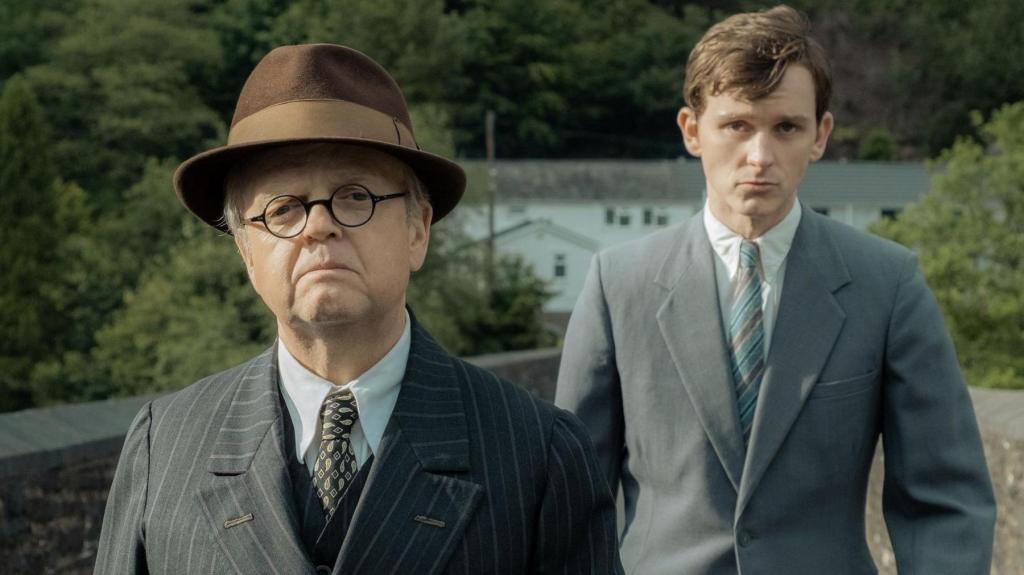
Mr Burton is a new British drama film directed by Marc Evans about the early years of Richard Burton’s career, beginning in his mid-teens, in the early days of the Second World War, and continuing up to the Festival of Britain year, 1951, when Burton played Prince Hal in Henry IV parts 1 and 2 at Stratford, and his status as a star was confirmed.
However, the Mr Burton of the title is not Richard, but Philip, Richard’s English teacher who somehow recognised the raw talent in the rather wild young Richard (then called Richard Jenkins), trained and mentored him, adopted him (hence the name change), and helped him get into Oxford University, and ultimately begin his career as an actor. Philip was so important to Richard’s career that Elizabeth Taylor once said in an interview that: “without Philip Burton there would never have been a Richard Burton”.
The story is interesting enough and the characters, Philip (Toby Jones) and Richard (Harry Lawtey) ought to be sufficiently interesting/dynamic respectively as to make this a sure-fire hit. And yet, it just never quite gets off the ground. The relationship between the two is interesting enough; Toby Jones is, of course, excellent as Philip; and Harry Lawtey makes a very creditable stab at young Richard, particularly in the later scenes when Richard’s voice has developed from the coarse young son of a Welsh miner into the Richard Burton we all know so well. But the way the story is told is very workmanlike and the background shots of the smoky drab industrial landscape that was the Pontrhydyfen of Burton’s youth are relentless and, ultimately, become rather tedious.
There were also a number of questionable details which sent me straight home to Melvyn Bragg’s biography ‘Rich’ for some fact-checking. The film shows Philip Burton as the man who first suggests Richard joins his playgroup at the YMCA; and singlehandedly talks the school into taking him back after he left prior to his School Certificate to earn some money and contribute to the household. But so far as I can tell, these roles were undertaken by Leo Lloyd and Meredith Jones respectively. The film also shows Philip paying £50 to ‘buy’ Richard from his father as part of the adoption process. But there seems to be no evidence to support this. In Philip’s diary there is no mention of any sum of money being paid, and the actual signature was secured by David Jenkins, a policeman and Richard’s brother, ‘with no difficulty’.
Okay, I get poetic licence and the need to simplify stories, but given how much Philip actually did for Richard, I do not see the need to give him credit for things he didn’t do. Laying it on just a little too thick, don’t you know!
In summary, this is an opportunity missed. The acting was good, but the storytelling and direction were just a little too pedestrian. There were occasional flashes which served to show how good a film it might have been, particularly towards the end in Stratford, but these were too few and too late to save the film.
 Richard Online
Leave a comment